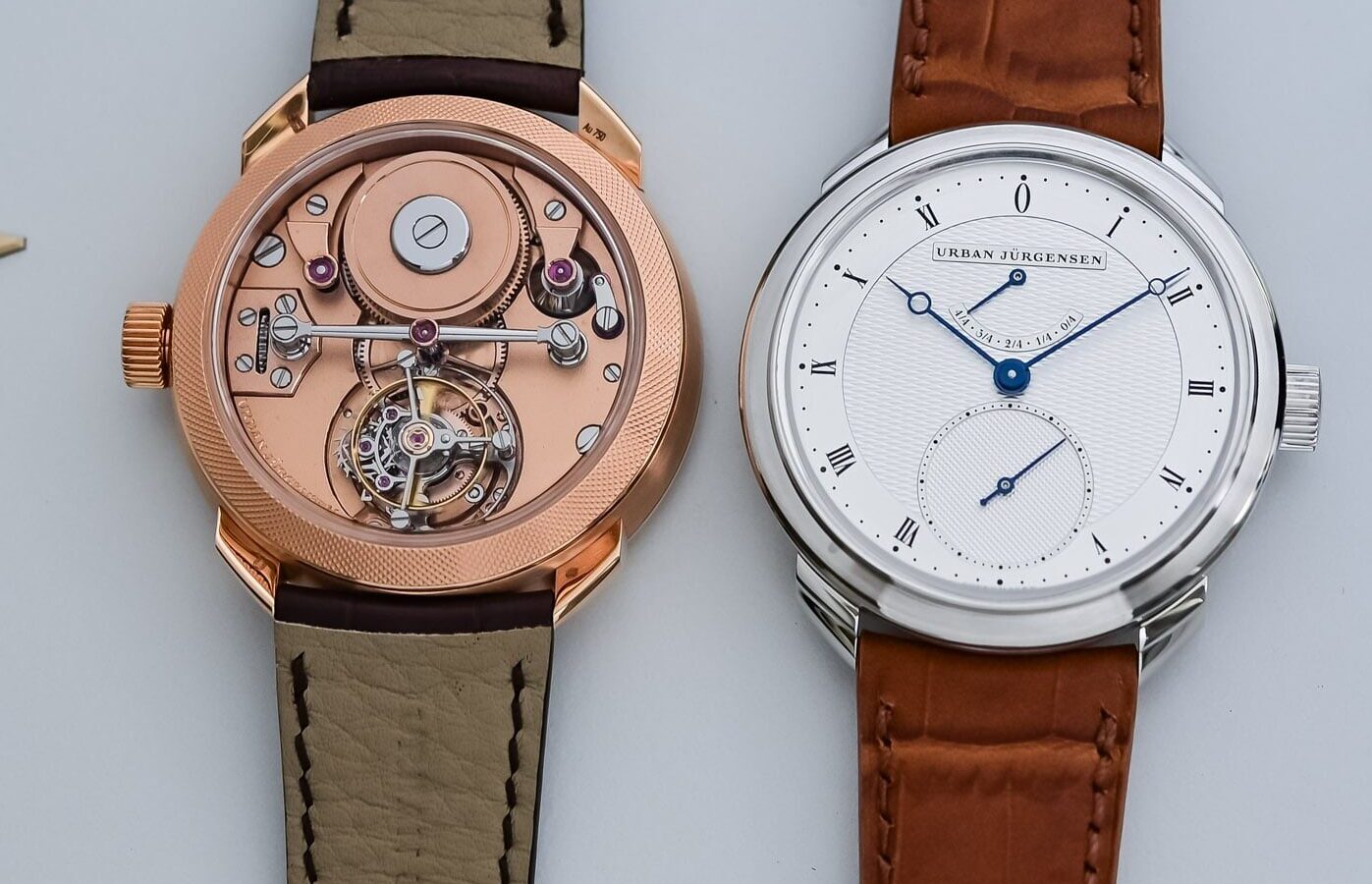
When Urban Jürgensen relaunched in 2025 under the co-direction of Kari Voutilainen and Alex Rosenfield, the inaugural collection comprised three references. The UJ-2 presented a time-only calibre with a double-wheel natural escapement; the UJ-3 an integrated perpetual calendar. The UJ-1 Tourbillon, designated the 250th Anniversary Watch, was conceived as the technical centrepiece of the revival. Its movement architecture is not an original design so much as a disciplined act of reconstruction: a miniaturised and adapted translation of Derek Pratt’s Oval pocket watch into a 30mm wristwatch calibre.
The Source Material: Pratt’s Oval Pocket Watch
Understanding the UJ-1 requires understanding what it is derived from. Derek Pratt began the Oval pocket watch in 1982. Development continued for more than two decades, and the watch was eventually assembled and finished with the involvement of Kari Voutilainen, completed in 2006. The Oval is widely regarded as one of the significant works of contemporary independent watchmaking. Its movement measured 76mm by 62mm. It was key-wound and key-set, with the winding and setting interfaces located on the movement’s back rather than at the periphery.
The UJ-1 is not a wristwatch version of the Oval in any literal sense. There is no oval case, no thermometer, no moon phase. What Voutilainen has done is reconstruct the movement’s structural logic, its bridge layout, its spatial organisation, and its core mechanical systems, at wristwatch scale and in a format that can be worn rather than carried.
Resolving the Keyless Works Problem
The most consequential design decision in the UJ-1 concerns something the wearer will never see. A wristwatch requires a crown and a keyless works—the gear train that connects the crown to the winding and hand-setting functions. The conventional approach would have placed this mechanism on the visible movement side. That would have been straightforward, but it would also have disrupted the bridge layout and spatial composition inherited from Pratt’s architecture.
Instead, the entire winding and hand-setting mechanism was relocated to the dial side of the calibre. From the back, the movement reads as Pratt intended: a flying barrel, a monumental curved central bridge, and a one-minute flying tourbillon, with large areas of negative space giving the composition an unusual openness. The crown wheel and keyless works are present, but they are invisible, absorbed into the dial side and designed to leave no trace on the movement view.
The Flying Barrel and Power Reserve
The flying barrel is raised above the movement plane, contributing directly to the calibre’s three-dimensionality. It incorporates a Geneva stop-work and delivers 47 hours of power reserve, running at 18,000 vibrations per hour. Extended autonomy was clearly not the objective; the barrel’s energy output also feeds a mechanically demanding regulating system.
The power reserve indication itself draws on marine chronometry. A cone-and-feeler mechanism translates the mainspring’s state of wind into a dial display: as the mainspring winds and unwinds, a threaded cone moves vertically, and a feeler with a ruby roller follows the cone’s changing height, converting that motion into the reserve indication. It is a considerably more complex solution than the task strictly requires, and it occupies meaningful space within the calibre.
The Tourbillon Carriage and the Remontoir
The regulating system is where the UJ-1’s mechanical character is most concentrated. The one-minute flying tourbillon incorporates an integrated remontoir d’égalité that operates once per second inside the tourbillon carriage, based on Derek Pratt’s system for the Oval. A mainspring does not deliver constant torque; the remontoir acts as an intermediary energy store, periodically releasing a controlled quantity of energy to the escapement rather than allowing the variable output of the mainspring to reach it directly.
The mechanism centres on a Reuleaux triangle—a steel component of constant width—that rotates between a two-pronged lever with ruby contact surfaces, governing the charge and release of the remontoir spring. The once-per-second release also produces a dead-beat seconds display: the small seconds hand advances in discrete, even increments, each step corresponding to one remontoir cycle.
The tourbillon cage geometry follows from this mechanism rather than from any decorative intention. The remontoir’s integration into the carriage creates an uneven mass distribution, and the cage’s asymmetrical three-arm form is a direct response to the poising requirement. Its shape is determined by function.
The escapement is a Swiss lever paired with a balance wheel fitted with micrometric timing screws and a hairspring with a Phillips terminal curve. The Oval used an Earnshaw-style spring-detent escapement. The lever escapement in the UJ-1 is a considered adaptation rather than a concession: a detent escapement is well suited to a pocket watch carried in a stable position, but a wristwatch is subject to continuous positional variation and shock. The lever escapement is the appropriate solution for a watch intended to be worn.
What the Movement Architecture Communicates
Viewed from the back, the UJ-1 presents a composition of three principal elements separated by deliberate negative space. The visual restraint is a consequence of the decision to hide the keyless works on the dial side; the movement reads as simpler than it is. The curved central bridge, the suspended barrel, and the tourbillon carriage are the only structures the eye encounters. Finishing quality and spatial proportion carry the full weight of the aesthetic, without ornamental support.
The UJ-1 Tourbillon is part of the three-reference inaugural collection launched when Urban Jürgensen returned in 2025, positioned as the collection’s technical flagship.