Jaeger-LeCoultre introduced the Duometre Heliotourbillon Perpetual in 2024, and for 2026 the manufacture has released a new limited-edition version in 950 platinum — reference Q6206150 — paired with a matching five-link 950 platinum bracelet. The shift from the original gold model to platinum is not simply a material substitution. It changes the finishing logic of the case, the tonal register of the dial, and the way the watch reads on the wrist. Understanding those consequences requires starting with the movement, because in the Duometre family the movement architecture is the primary constraint on everything visible from the front.
Two Barrels, Two Spatial Zones
The calibre 388 at the heart of this watch is manually wound and operates at 3Hz. Its defining structural feature is the presence of two independent mainspring barrels. One barrel powers the regulation system, which includes the Heliotourbillon. The other powers the perpetual calendar mechanism. Each barrel carries a power reserve of 46 hours, and each has its own labeled indicator on the dial. Winding requires deliberate attention: turning the crown in one direction winds one barrel, turning it in the opposite direction winds the other. They do not wind simultaneously.
This separation of energy sources is the foundational premise of the Duometre concept — the complications cannot draw power from the regulation system, so neither side compromises the other. From a design standpoint, the consequence is immediate: the dial must accommodate two discrete power reserve displays in addition to the time and the full perpetual calendar output. That is a significant information load, and it imposes a strict spatial logic. The time display sits off-center, which is not an aesthetic choice made for novelty but a direct result of allocating dial real estate to the Heliotourbillon assembly and the calendar indications. The perpetual calendar here includes a year indicator and a moon phase, making the complication unusually complete.
The Heliotourbillon as a Spatial Anchor
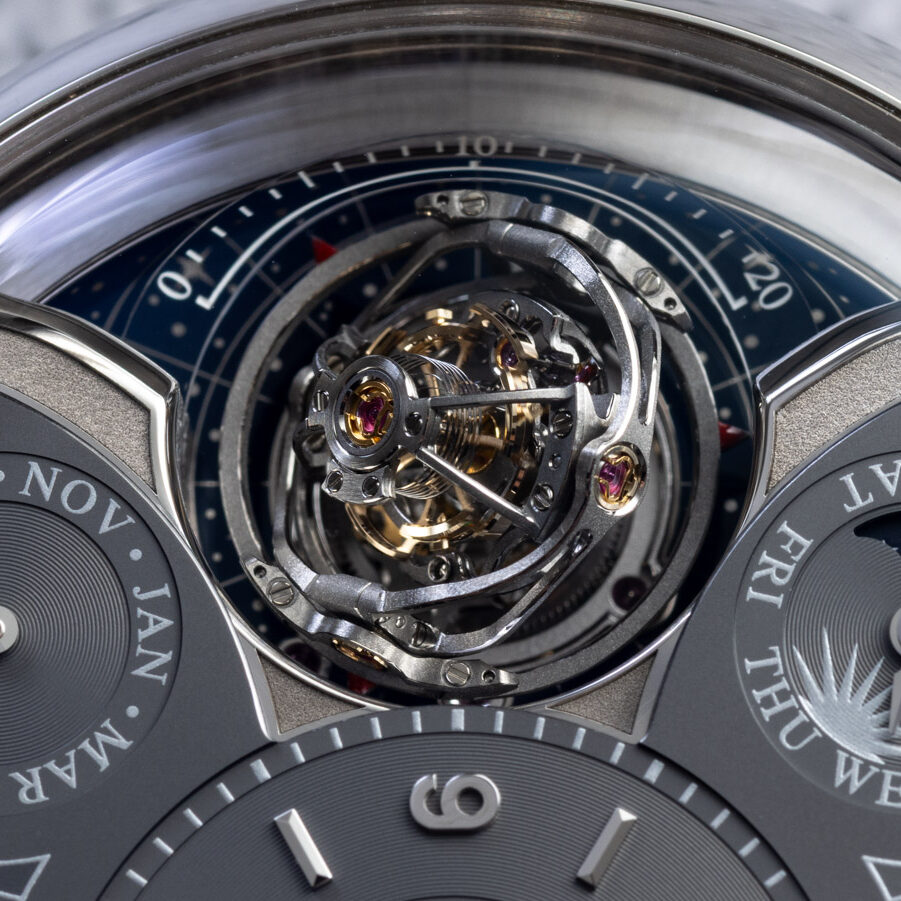
The Heliotourbillon is the most spatially demanding element on the dial. Unlike a conventional tourbillon, the entire assembly not only rotates but sways, covering a broader range of positions — the intent being to counteract gravitational error across more of the orientations a wristwatch actually encounters in daily wear. The system incorporates a cylindrical hairspring, an additional feature directed at timing consistency. All of this mechanical complexity adds physical volume, which is why the case measures 44mm wide and 14.7mm thick.
The Heliotourbillon is mounted in a sunken section on the left side of the dial. This recessed zone is described as the one area of the dial that carries genuine color, providing a visual anchor against the otherwise gray composition. A sapphire crystal window on the side of the case offers a secondary view of the assembly in motion — a considered detail that acknowledges the mechanism’s visual interest without forcing the dial to expose more of it than the layout can absorb cleanly.
What Platinum Demands of Finishing
The case is 950 platinum throughout, and the decision to finish the bracelet links with brushing rather than polishing is worth examining carefully. Polished platinum is the conventional expectation for a precious metal bracelet at this level of complication. Brushed links read differently: they suppress the high-contrast reflectivity that polished platinum produces and instead distribute light evenly across the surface. On a watch whose dial is composed entirely in gray tones, a polished bracelet would compete with the dial for visual attention. The brushed finish keeps the bracelet subordinate to the dial composition while still communicating the density and quality of the metal — platinum’s weight makes that quality unmistakable on the wrist regardless of surface treatment.
The all-gray tonal register of the dial and case serves legibility in a specific way. With this many indications to read — time, two power reserves, perpetual calendar with year and moon phase — a high-contrast color scheme risks visual fragmentation. The unified gray palette holds the composition together and allows the hierarchy of information to be established through layout and scale rather than color differentiation. The trade-off, as is honest to acknowledge, is that the watch asks something of the wearer’s eye; extended reading under low light requires attention.
Case Geometry and Wearability
A 44mm, 14.7mm case in 950 platinum is a substantial object. Jaeger-LeCoultre addresses wearability through the lug geometry: the lugs are described as highly sloped, which distributes the case across the wrist and reduces the perception of height. The combined weight of the case and bracelet is considerable — the source material describes it as precisely the feeling one expects from a traditional heavy precious timepiece, framing the weight as appropriate rather than excessive. The water resistance is rated to 30 meters, consistent with a formal dress watch rather than a tool watch.
The movement is visible through the caseback. The calibre 388 departs from the German silver bridges that characterized earlier Duometre movements; the finishing here relies on platings and surface treatments rather than the raw alloy aesthetic associated with that tradition. The result is a movement that reads as technically accomplished without referencing the specific visual language of German silver finishing.
The Q6206150 is a limited edition. Jaeger-LeCoultre has not released this configuration previously — the platinum case and matching platinum bracelet combination is specific to this 2026 reference, distinct from the gold model that introduced the Heliotourbillon Perpetual in 2024.