Minerva’s The Unveiled Crownless does exactly what its name states: it removes the crown entirely. There is no hidden crown, no retractable crown, no recessed pushpiece standing in for one. The case flank is uninterrupted polished steel on all sides, and every function the crown once performed has been reassigned to the bezel. That single decision cascades through the case construction, the movement architecture, and the tactile experience of wearing the watch.
A Case Geometry Defined by Absence
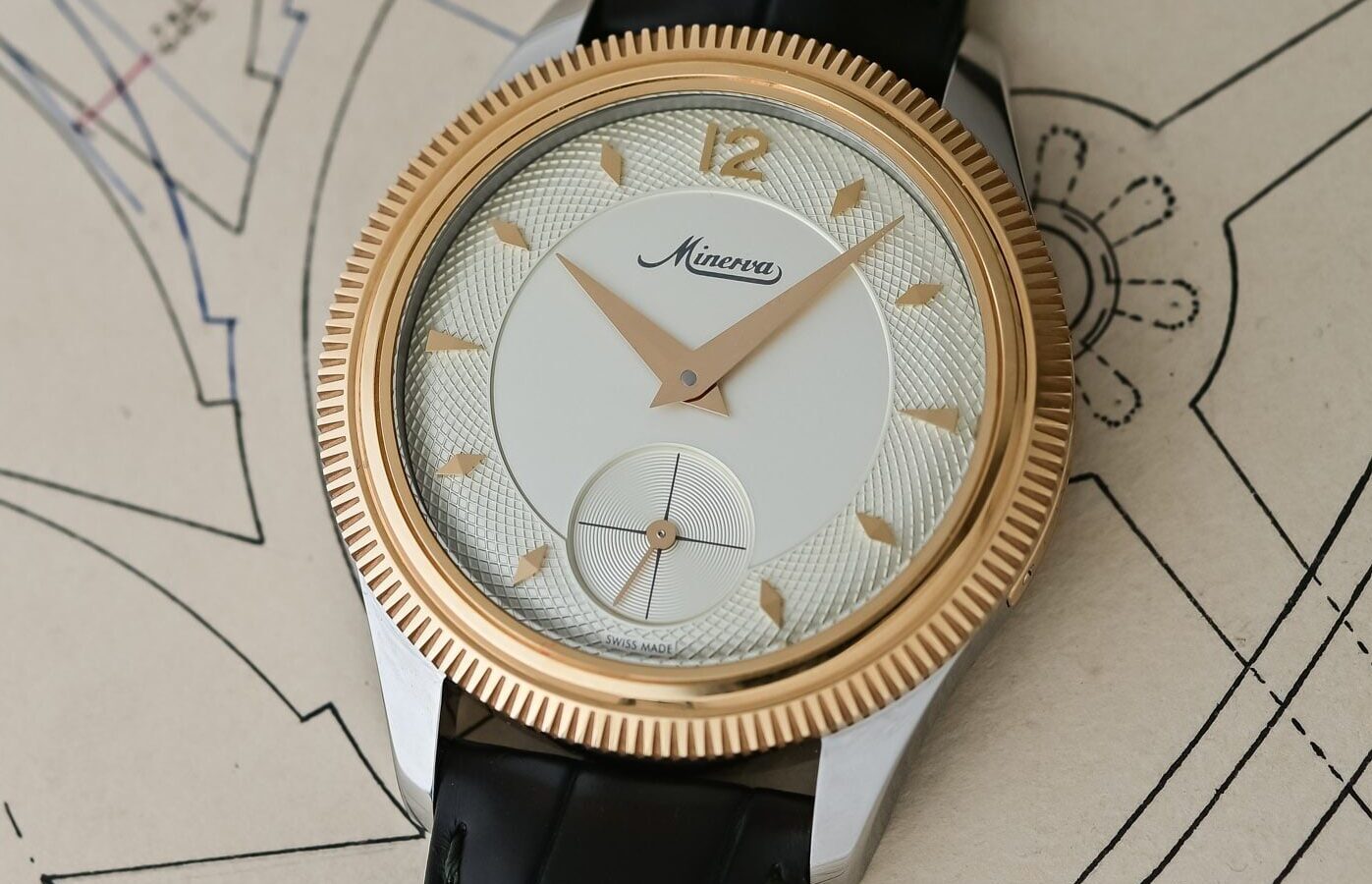
At 41.5mm in diameter and under 12mm thick, the Crownless occupies a proportion that reads as contemporary rather than vintage, despite the classical character of its dial. What the dimensions alone cannot communicate is the visual effect of a fully symmetrical case. Without any protrusion on the flank, the eye has nowhere to anchor except the bezel itself — a bidirectional ring in warm rose gold with a fluted surface that becomes the watch’s dominant formal element. The polished steel case recedes; the bezel leads.
The downward-curving lugs assist wrist fit and allow the case to settle without the crown pressing against the back of the hand — a comfort detail that only registers after time on the wrist. One legitimate criticism of the lug geometry, consistent with other recent Minerva references, is that the lug hole positioning causes the lug tip to angle noticeably on smaller wrists. It is a proportional issue worth noting, particularly given how carefully the rest of the case has been considered.
On the left flank, a discreet rose-gold plaque engraved with Depuis 1858 marks Minerva’s founding year without disrupting the case’s overall symmetry. The dial side is protected by a domed, box-shaped sapphire crystal with double anti-reflective coating; the caseback is also sapphire, providing a clear view of the movement.
The Bezel as Primary Interface
Reassigning winding and time-setting to the bezel is not a new idea for Minerva. The lineage traces to a 1927 military watch with a bezel-operated timing function, and the concept reappeared in The Unveiled Timekeeper of 2023, which used the bezel to control its chronograph. The Crownless extends that logic to a time-only configuration, which demands a cleaner and more precise switching mechanism.
That mechanism is a small lever concealed within the caseback, positioned next to the 3-bar water-resistance engraving. Pushed in, the lever couples the bezel to the winding function; pulled out, it switches to time-setting mode. The action is described as precise and deliberate, and the two states are distinct enough that accidental mode changes are not a practical concern. Water resistance architecture benefits directly from the crown’s absence — there is simply no crown tube to seal, which removes one of the most common points of ingress vulnerability in conventional case construction.
The bezel itself is bidirectional, and the winding action through it is reported to feel more engaging than a conventional crown, partly because the larger surface area distributes the rotational effort differently. Time-setting is equally functional. After brief familiarisation, the interface becomes habitual.
Dial Design and Finishing
The dial draws directly from Minerva’s mid-twentieth-century aesthetic. An opaline centre in a warm ivory tone is surrounded by a finely guilloché outer ring, a combination that catches light subtly rather than assertively. Applied faceted hour markers — predominantly rhomboid in form, with triangular markers at 3 and 9 o’clock — ring the dial, interrupted by a large applied Arabic numeral at twelve. Rose gold-coated dauphine hands complete the classical hand set, and a recessed small-seconds display at six provides visual balance to the layout.
The finishing is restrained throughout. Nothing on the dial competes with the bezel for attention, which is the correct hierarchy given that the bezel is now a functional control surface as much as a design element.
Calibre M15.08: Movement Architecture Built for the Concept
Removing the crown required a new movement. Manufacture calibre M15.08 was developed specifically for the Crownless and is produced entirely at Minerva’s Villeret workshops. Its base is shared with the 1858 Geosphere Annual Calendar and connects historically to the Pythagore calibre 10-48, created in 1943 by André Frey. The movement is manually wound, beats at 18,000 vibrations per hour — a frequency long associated with classic Minerva calibres — and delivers an 80-hour power reserve from a generously sized mainspring.
Visible through the sapphire caseback, the rhodium-plated German silver bridges carry Geneva stripes, polished bevels, and circular graining. A large free-sprung balance dominates the view, flanked by an arrow-shaped regulator and bridges whose proportions are a deliberate part of the visual composition. The finishing standard is consistent with what Minerva has established across its independent-era references.
What the Design Argument Actually Is
The Unveiled Crownless is not a watch that argues the crown was always wrong. It is a watch that asks whether the crown is the only viable answer to the interface problem — and then builds a coherent alternative. The case geometry, the bezel mechanics, the caseback lever, and the purpose-built movement are all consequences of that single question. Each element is resolved on its own terms rather than adapted from a conventional template.
The result is a 41.5mm steel watch with a rose-gold bezel, an ivory guilloché dial, and no crown — a configuration that is genuinely unusual in current production and grounded in a specific, traceable design rationale rather than novelty for its own sake.