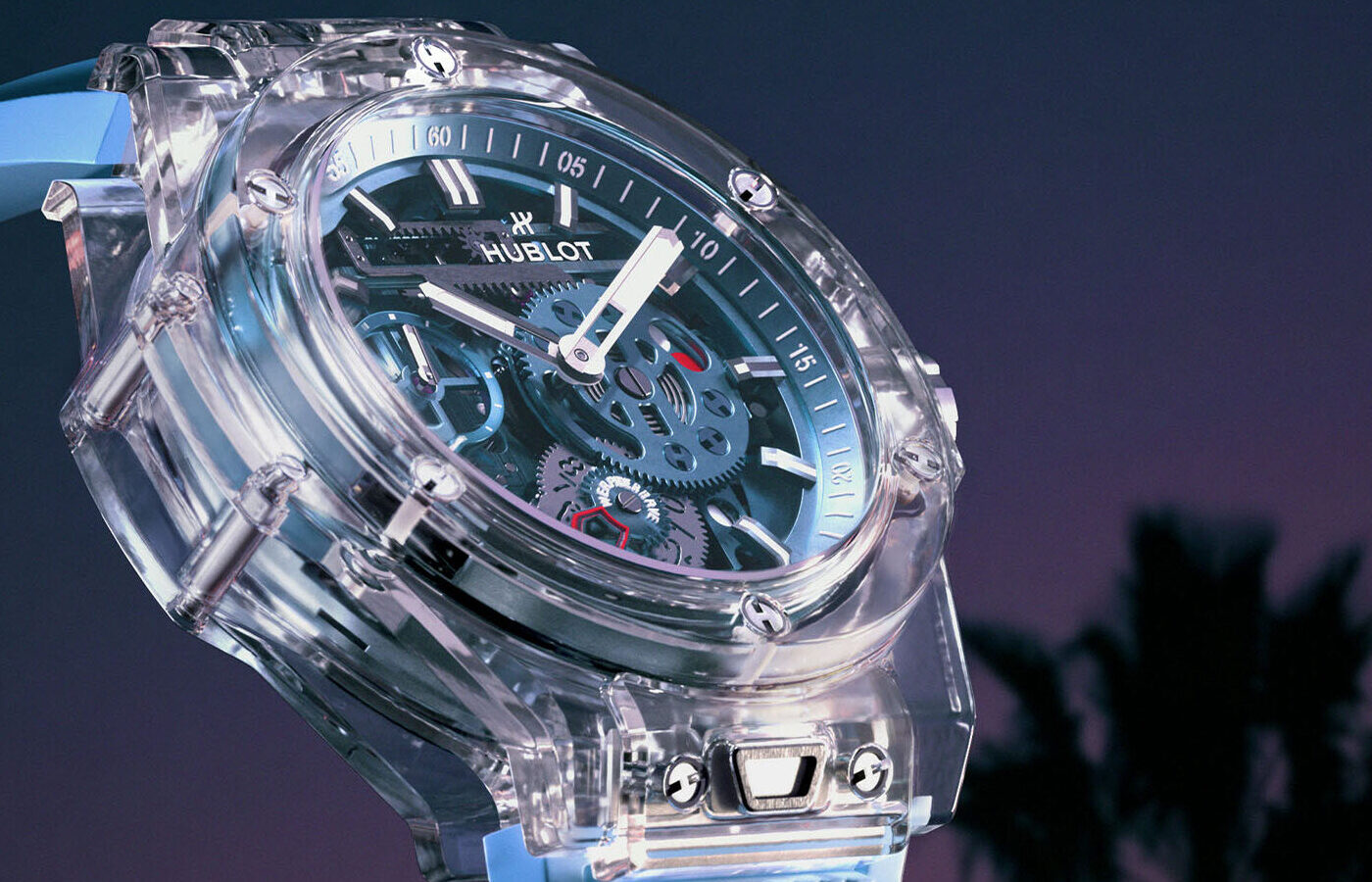
Hublot introduced its first sapphire Big Bang in 2016. A decade on, the material has become a recurring design language for the brand rather than a one-time technical demonstration. The latest expression is the Big Bang Sapphire Sky Blue, a limited edition of 100 pieces that brings a new colour to the Big Bang Meca-10 lineup. The case is 44mm in diameter, constructed entirely from polished sapphire crystal, and houses calibre HUB1201 — the manually wound, skeletonised movement that has defined the Meca-10 since its debut in 2016.
Why Sapphire Changes the Design Problem Entirely
Working with sapphire as a case material is not an extension of conventional case manufacturing. Sapphire is one of the hardest materials used in watchmaking, which makes machining it into a three-dimensional enclosure — rather than a flat crystal — an entirely different category of technical challenge. The tolerances required to produce a polished sapphire case with consistent wall thickness, clean apertures for crown and pushers, and a bezel seat that holds geometry under the pressure of six H-shaped titanium screws demand processes that most manufacturers do not have in-house.
The consequence for design is immediate. Because sapphire transmits light rather than reflecting it the way metal does, the visual mass of the case behaves differently at every angle. A polished metal case reads as a solid object with defined edges. A polished sapphire case of the same diameter reads as something closer to a lens — its boundaries shift with the light, and the interior of the watch becomes part of the exterior composition. At 44mm, the Big Bang’s proportions were already conceived around a bold, layered sandwich construction. In sapphire, that layering becomes the primary visual event rather than a structural detail hidden beneath a dial.
The Meca-10 Architecture as a Sapphire-Specific Solution
The Big Bang’s sandwich construction — where the case is built up from stacked, visually distinct layers — is particularly well suited to sapphire. The transparency of the case means every layer is legible from the outside, so the architecture has to be resolved as a complete three-dimensional composition, not just a front face. The Meca-10 movement, calibre HUB1201, is fully skeletonised across its 223 components, which means there is no closed dial plane to interrupt the view through the case. The movement and the case become a single optical system.
The sky-blue colour treatment is applied to the skeleton dial and the movement bridges, not to the sapphire itself. The case remains clear. This separation of colour and material is a considered decision: the matte sky-blue surfaces sit inside a transparent polished enclosure, visible through it but distinct from it. The contrast between the matte finishing on the bridges and the high polish of the sapphire case creates a layered depth that a coloured metal case could not produce in the same way.
Movement Visibility and the Power-Reserve Display
Calibre HUB1201 runs at 21,600 vibrations per hour and is wound manually, with twin mainspring barrels delivering a 240-hour — ten-day — power reserve. The power-reserve indication uses a rack-and-pinion mechanism with two sliding racks that move along a 9 o’clock to 3 o’clock axis. This gives the Meca-10 its signature dual display: a continuous power-reserve readout at 6 o’clock and a low-reserve indicator at 3 o’clock that marks a red zone when the movement is within its final two days of reserve. Running seconds appear at 9 o’clock.
In a conventional case, these indications would be read as dial information. In the sapphire Big Bang, the rack-and-pinion mechanism itself is part of what you are looking at. The sliding racks are visible components moving across the movement plate, and the sapphire caseback — also treated with an anti-reflective coating, as is the front crystal — means the same mechanical display is readable from the reverse. The movement is not decorated for visibility as an afterthought; the Meccano-inspired skeletonisation was the original design intent of the HUB1201, and the sapphire case simply removes the last barrier between the mechanism and the observer.
Finishing and Strap Integration
The bezel is secured by six H-shaped titanium screws — a detail that introduces the only metallic element on the case exterior. Titanium’s lower visual weight relative to steel or gold keeps the hardware from competing with the sapphire, while the H-screw geometry remains one of the Big Bang’s most recognisable formal signatures. The strap is described as a sky-blue lined structured rubber with a titanium deployant buckle clasp, continuing the colour theme from the movement bridges through to the wrist fitment. Water resistance is rated to 50 metres.
The Big Bang Sapphire Sky Blue is limited to 100 pieces and carries reference 424.JX.5120.RX. It is available at selected Hublot points of sale and through Hublot’s website.