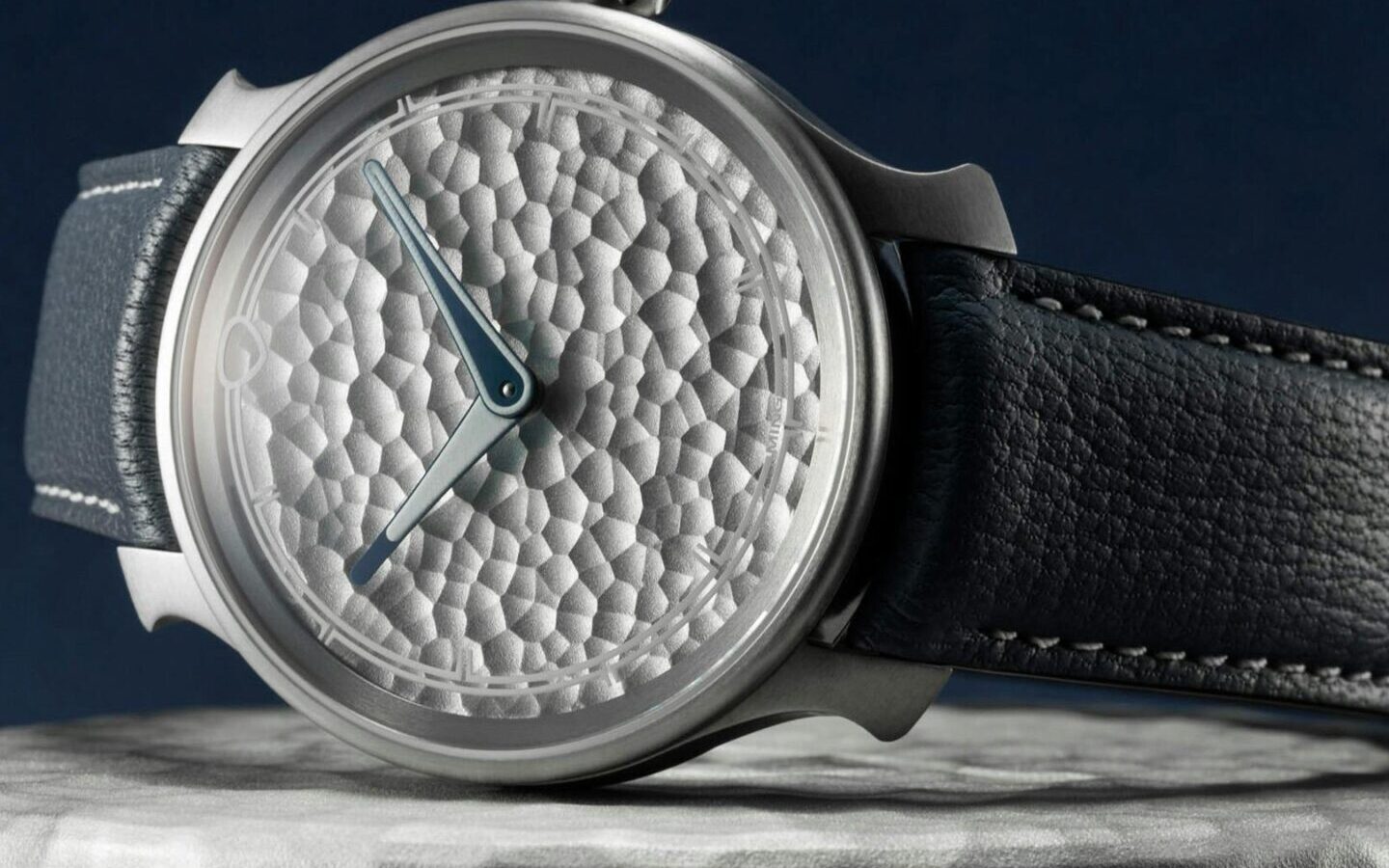
Ming’s 37.06 Royal Selangor, announced on 30 July 2026, is an 88-piece limited edition built around a hand-hammered pewter dial produced by Royal Selangor, the Kuala Lumpur-based pewter manufacturer founded in 1885. The collaboration is a deliberate departure for a brand whose design language has been defined by precision-layered dial construction, controlled luminescence and a consistently contemporary minimalism. Introducing a material shaped by hand into that system raises a straightforward but demanding design question: how do you hold a composition together when one of its primary surfaces is, by definition, unrepeatable?
The Material: What Pewter Actually Is
Pewter is a tin-based alloy — in Royal Selangor’s case, cast from stock with 97% tin content, fortified with small amounts of copper and antimony. It does not tarnish or corrode easily and develops a soft patina over time. These are not incidental properties; they bear directly on how the dial will age relative to the titanium case surrounding it. The manufacturing process at Royal Selangor’s Setapak factory remains heavily manual: the alloy is melted, poured into casting moulds, cooled, then filed, polished and finished. For the 37.06, the finishing step is hand-hammering, which produces the irregular indentations — dimples of varying depth and spacing — that give the dial its surface character.
That variability is the central design tension. Royal Selangor employs over 200 craftspeople and a design team of 40, but no two hand-hammered surfaces will be identical. In a production run of 88 pieces, each dial will catch light at slightly different angles, with slightly different rhythm across its surface. For a studio that has built its reputation on exacting dial geometry and repeatable finish quality, accepting that variability is a considered position, not an oversight.
Case Construction and Proportions
The 37.06 uses the existing Ming 37 case architecture: 38mm diameter, 11.05mm thick, with a lug-to-lug span of 44.73mm and a lug width of 20mm. The head weighs 35.9 grams. The case material is grade 2 titanium — a commercially pure form at 99.8% titanium — which is softer and more difficult to machine than the grade 5 alloy more commonly used in watchmaking, and cannot be polished. The entire case is brushed, producing a matte, low-reflectance surface.
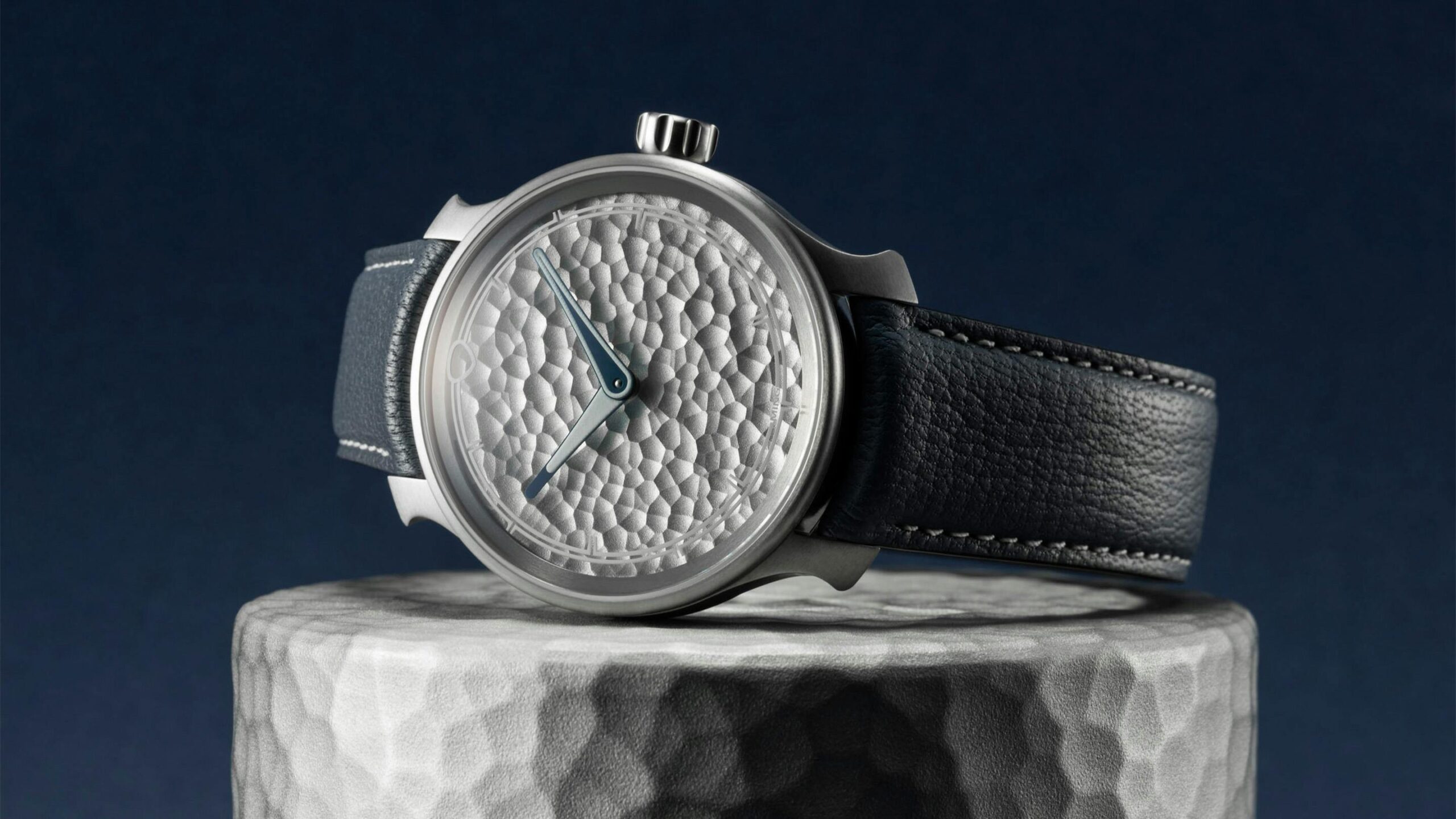
That finishing decision is significant in the context of this dial. A polished case would compete with the pewter’s own soft metallic sheen; a brushed grade 2 titanium surface recedes instead, allowing the hammered dial to carry the visual weight. The result, as intended, is a monochromatic composition — grey on grey — differentiated by texture rather than contrast of tone or material colour.
The case retains the Ming 37’s signature pagoda-style flared lugs, double-domed sapphire crystals front and rear with double-sided anti-reflective coating, an oversized notched crown with double gaskets, and water resistance to 100 metres.
Dial Architecture and Luminescence
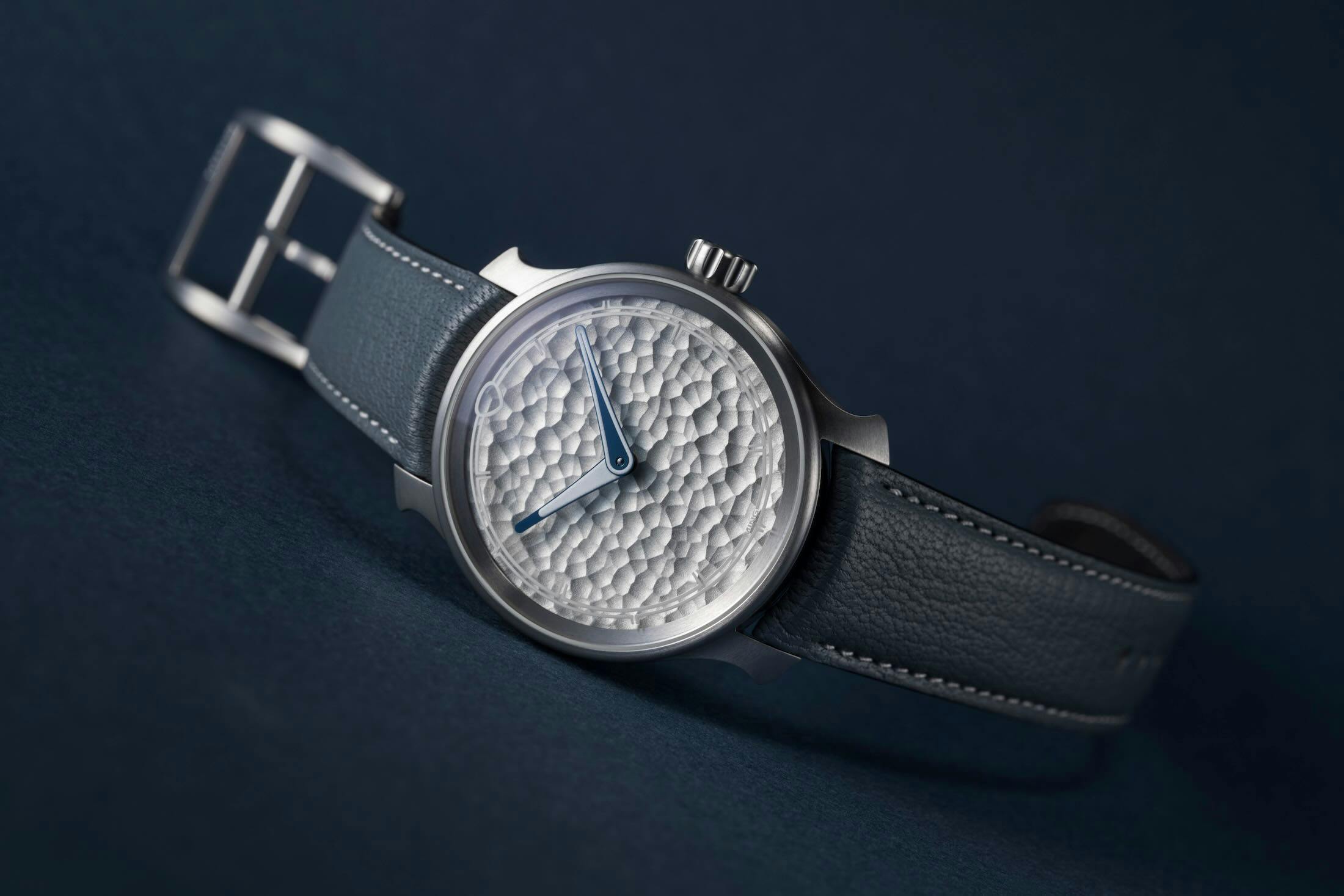
The dial itself carries no brand markings. The chapter ring — a structural element laser-cut into the underside of the sapphire crystal rather than applied to the dial surface — is filled with blue-emitting Super-LumiNova X1. The same material coats the central hour and minute hands. This approach, consistent with other Ming 37 references, keeps the dial plane uncluttered while embedding the luminescent system into the crystal layer above it.
Against a hand-hammered pewter surface, this separation of layers becomes more legible. The dial’s organic texture sits at one depth; the chapter ring and its luminescent fill occupy another plane entirely, suspended in the crystal. The hands move across both. The layering that has always been part of Ming’s dial construction reads differently here because the base layer is no longer flat or uniform — it has relief, shadow and directional variation depending on the light source.
Movement and Assembly
The calibre is a customised Sellita SW300-1 — designated the SW300-M1 for Ming — measuring 25.6mm in diameter and 3.6mm thick. It runs at 28,800 vibrations per hour and delivers a 50-hour power reserve. The baseplate carries an anthracite coating; the bridges are skeletonised, as is the rotor. The movement is visible through the rear sapphire crystal, where the caseback also carries the engraved names of both Ming and Royal Selangor — the only place branding appears on the watch.
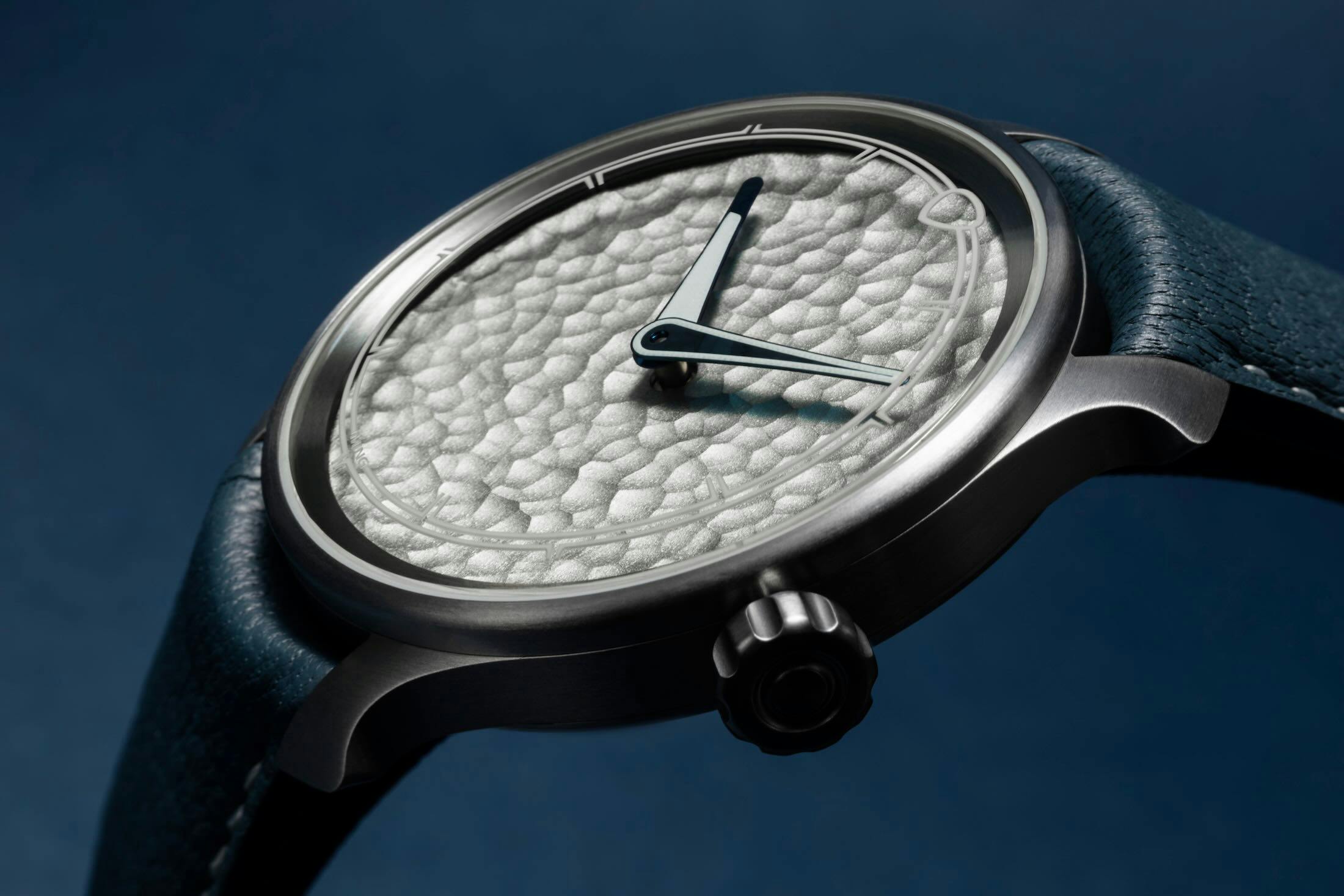
Notably, the 37.06 Royal Selangor will be assembled locally in Kuala Lumpur, which the brand identifies as a first. The watch is paired with a blue-grey goat leather strap by Jean Rousseau, fitted with curved quick-release spring bars and a flying blade tuck buckle with micro-adjustment. The presentation box is itself made by Royal Selangor and finished with the same hand-hammered surface treatment as the dial.
The 88 pieces will be available from Royal Selangor boutiques from 30 July 2026, with a small allocation available through ming.watch from 6 August 2026.