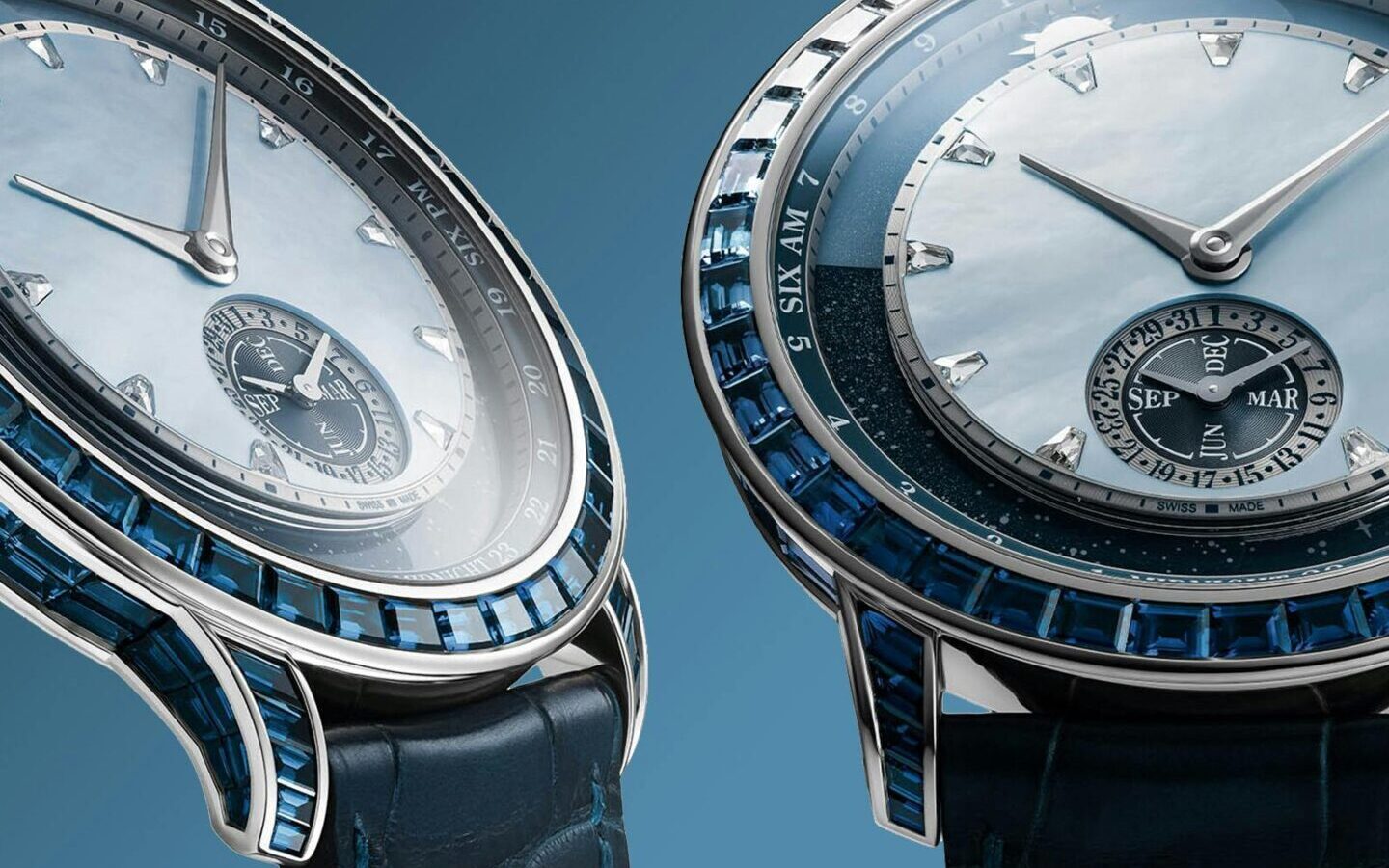
The Krayon Anywhere Parhelion, introduced in July 2026, takes the Geneva-based independent’s established astronomical complication and rebuilds its visual logic almost entirely around gemstones. This is not a case of stones applied to an existing design as a finishing upgrade. The gem-setting here functions as the primary design language, and that shift has direct consequences for how the case is constructed, how the dial is read, and how finishing hierarchy is established across the object.
Case Material and the Logic of a Naturally White Alloy
The 42mm case is crafted from an 18k white gold alloy with a high palladium content. The practical consequence of that formulation is significant: the alloy achieves a bright, permanent white finish without rhodium plating. For a watch whose surface is largely defined by the colour behaviour of its stones, eliminating a plated layer removes one variable from the chromatic equation. The metal reads as a neutral, stable ground rather than a surface treatment that will wear differently over time. At 9.5mm thick, the case remains restrained in profile for a watch carrying this level of surface complexity.
Sapphire crystals are fitted front and back, and the case carries a 30-metre water resistance rating. These are not incidental details. A display caseback on a gem-set watch is a considered choice: it extends the finishing logic to the movement side and asks the calibre to hold its own against the visual density of the exterior.
171 Stones, One Gradient, and the Year It Took to Source Them
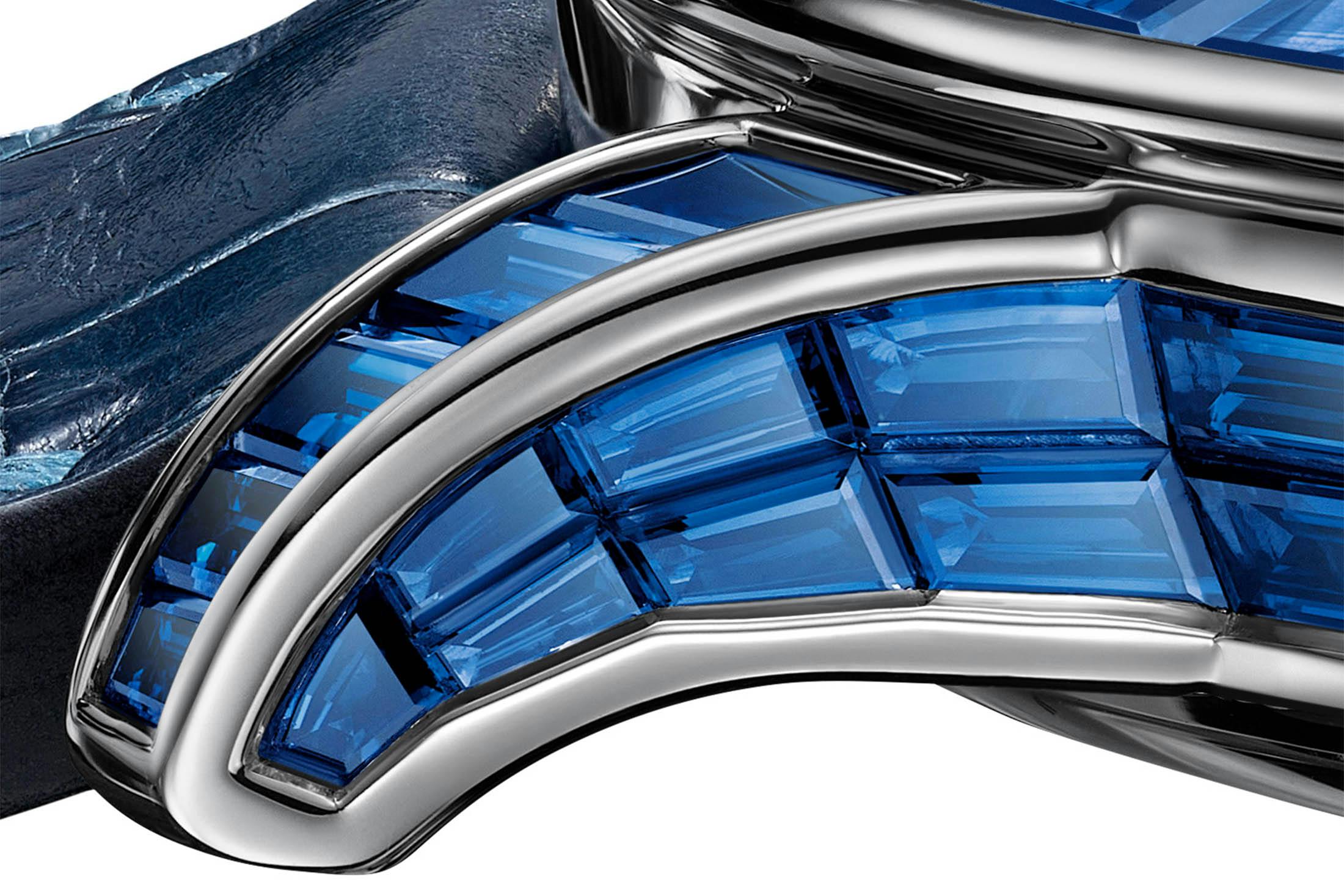
The total stone count is 171. Of these, 124 are baguette-cut sapphires distributed across the bezel, case middle, lugs, and crown side. A further 35 baguette-cut sapphires appear on the white gold pin buckle, carrying the same treatment onto the strap hardware. The remaining stones are on the dial, addressed separately below.
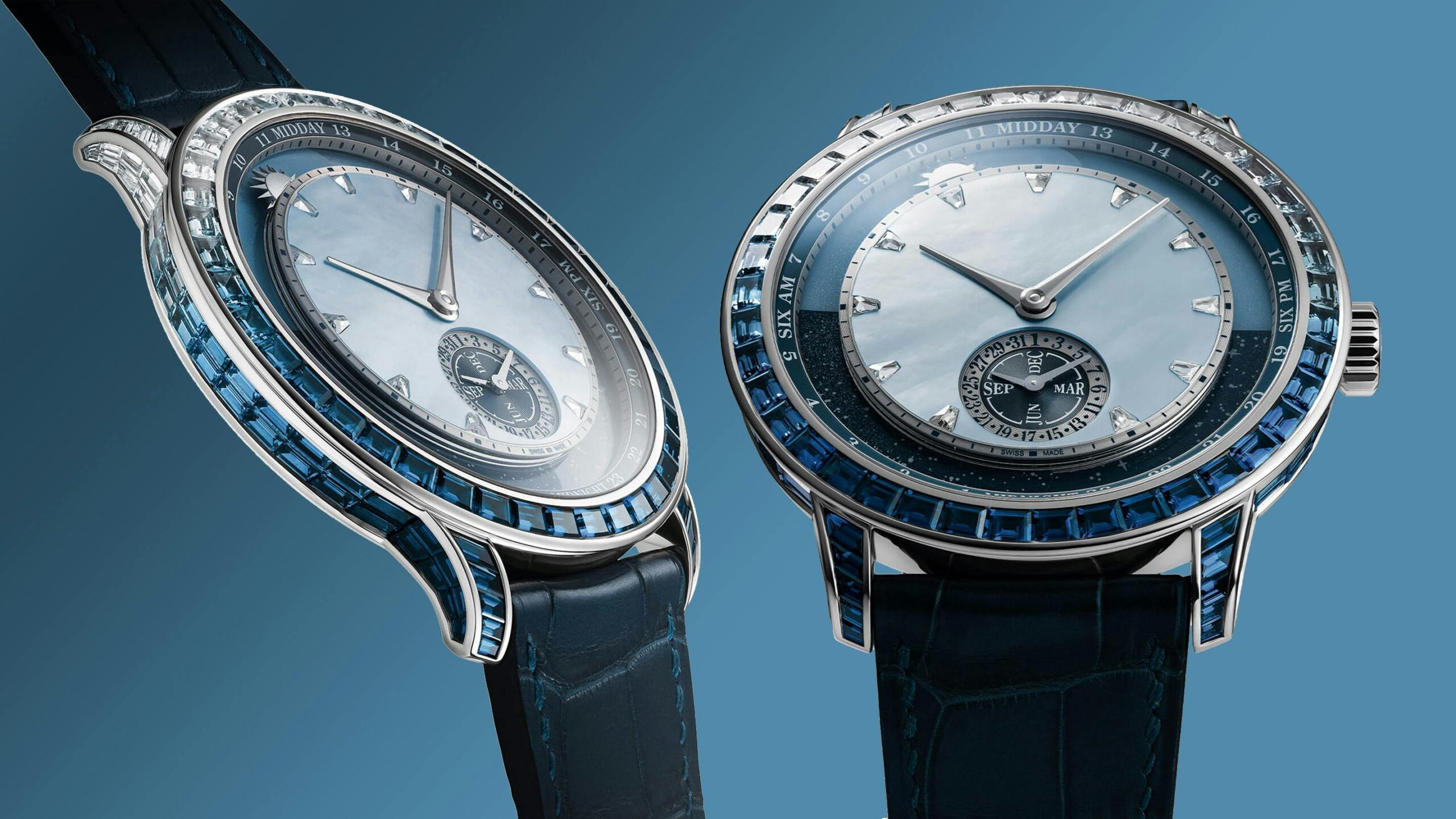
The defining characteristic of the sapphire setting is a colour gradient that progresses from white through multiple shades of pale blue to deep midnight blue. Baguette cuts are particularly unforgiving in this context: their flat, rectangular tables sit flush and adjacent, meaning any discontinuity in colour transition reads immediately. Krayon states that sourcing stones capable of producing a seamless progression required close to a full year. That timeline reflects the genuine difficulty of the task. Sapphires in the pale-to-mid blue range vary considerably in saturation and secondary hue, and matching them across 124 stones while maintaining a directional gradient demands selection at a level closer to gem-trading than standard watch procurement.
The gradient is not merely decorative. It maps the atmospheric phenomenon that names the watch: the parhelion, a rare optical effect produced when sunlight refracts through hexagonal ice crystals in high cold clouds, generating luminous arcs alongside the sun. Krayon founder Rémi Maillat and photographer Fei Hou witnessed the effect in Greenland, and the colour range of the stones — together with the mother-of-pearl dial — is a direct response to the light conditions of that landscape.
The Krayon Cut and the Problem of Dial Legibility
When a dial’s surround is this visually active, the dial itself faces a legibility problem. Krayon’s solution involves two distinct moves. The centre of the dial is mother-of-pearl, a material chosen for its shifting, iridescent reflections. Against the structured, directional colour of the baguette sapphires, the mother-of-pearl reads as fluid and atmospheric — a deliberate contrast that separates the dial plane from the case visually.
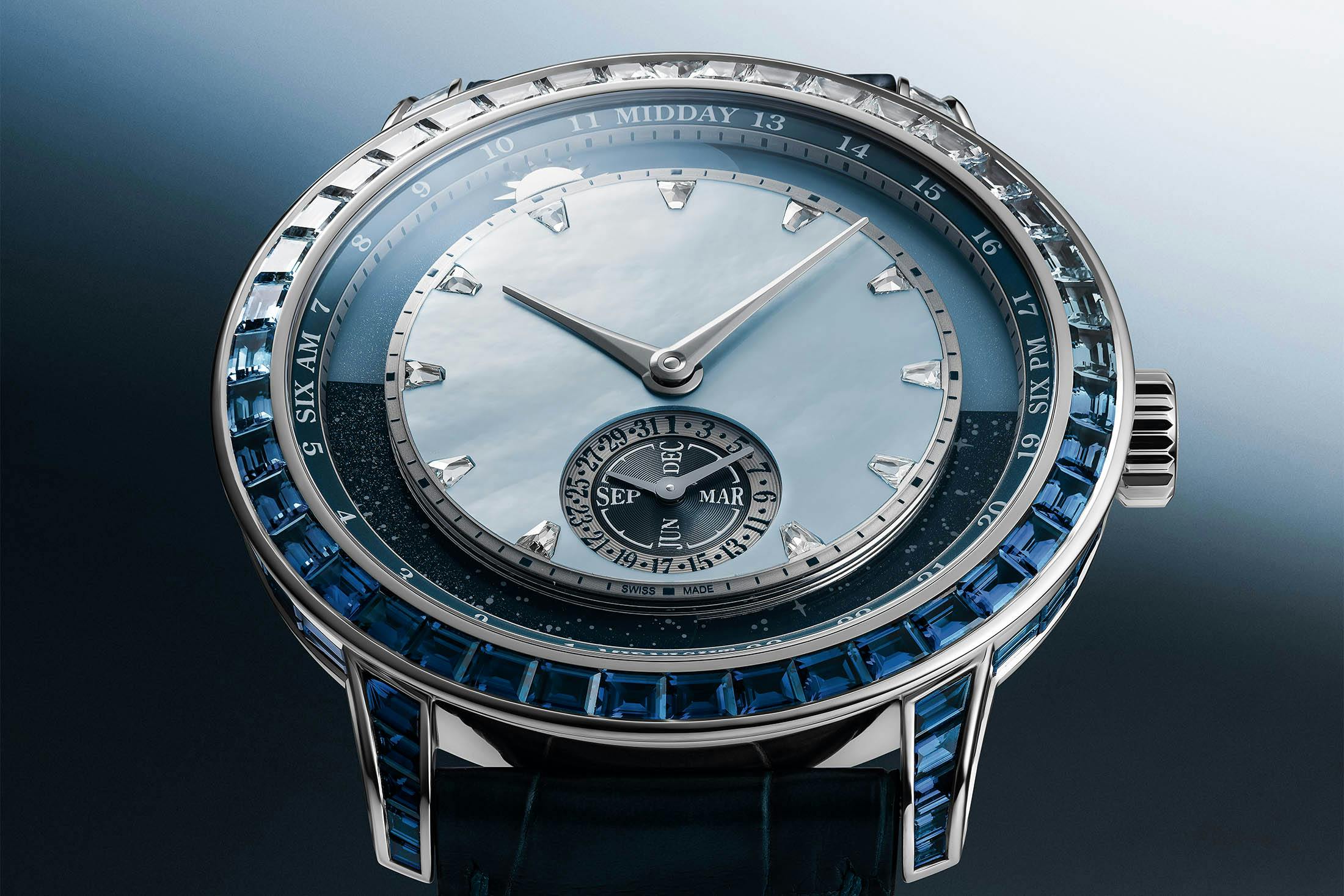
The hour markers are eleven diamonds set using an invisible setting, which creates the appearance of stones floating above the dial surface without visible metalwork. Each diamond is cut in what Krayon calls the Krayon Cut, a proprietary Y-shaped geometry developed specifically for this brand and echoing its logo form. A single white sapphire in the same cut appears at 12 o’clock on the bezel, designated as the symbolic brightest point of the parhelion effect.
The invisible setting is a technically demanding choice here. It requires precise undercutting of each stone’s girdle to seat it in a rail system with no prongs or bezels visible from above. On a dial already competing with an elaborately set case, it is the right call: any conventional setting would add visual noise at exactly the point where clarity is most needed.
The Complication and the Movement
The Anywhere complication displays sunrise and sunset times, a 24-hour indication, and a date. The peripheral inscriptions — MIDDAY, MIDNIGHT, SIX AM, SIX PM — retain Krayon’s established typography. Location calibration is handled by Krayon directly, allowing the watch to be reconfigured if the owner relocates.
The movement is the in-house hand-wound calibre C030, mechanically unchanged from previous Anywhere editions. It comprises 432 components and 55 jewels, runs at 21,600 vibrations per hour, and delivers a 72-hour power reserve. The movement measures 35.4mm by 5mm. The decision to leave the calibre mechanically identical is straightforward: the Parhelion is a design and materials exercise, not a complication development. The engineering effort went into the gem-setting and the alloy, not the movement architecture.
Strap and Buckle
The watch is worn on a dark blue alligator leather strap. The white gold pin buckle is set with 35 baguette-cut blue sapphires in the same graduating treatment as the case. Extending the gradient to the buckle is a disciplined choice — it closes the design system rather than leaving the strap hardware as an afterthought.
The Krayon Anywhere Parhelion is offered without a production limit.