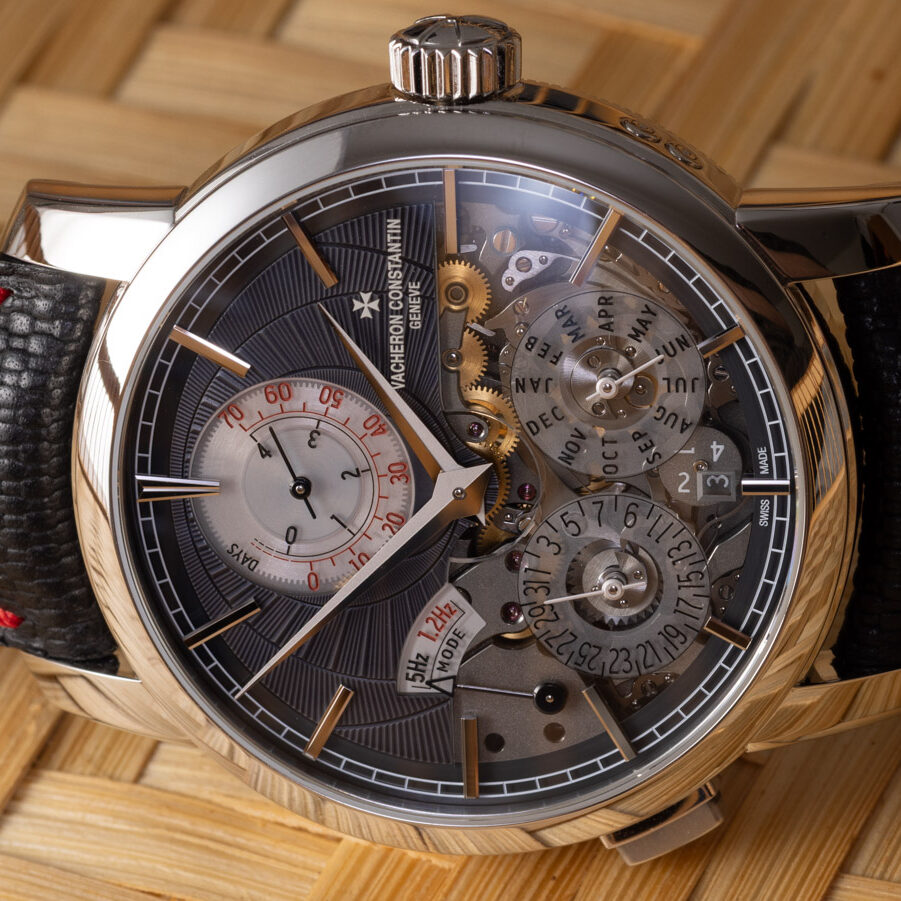
Vacheron Constantin’s 2026 update to the Traditionelle Twin Beat Perpetual Calendar, reference 3200T/000P-H167, arrives seven years after the original 2019 reference 3200T/002P-B578. The mechanical change is specific and measurable: the power reserve in passive mode increases from 65 to 70 days. Everything else about the watch’s fundamental architecture — its manually wound calibre 3610 QP, its two independent regulation systems, its perpetual calendar complication — carries forward from the original concept. The watch is not produced as a limited edition.
That single engineering delta, five additional days of passive reserve, is modest on paper. But it sharpens a design problem that was already present in 2019 and has not been fully resolved: how does a dial communicate two operationally distinct states to the wearer without becoming illegible in either one?
Two Regulation Systems, One Dial
The calibre 3610 QP contains two balance wheels running at different frequencies. One oscillates at 5Hz — a high-beat rate comparable to movements from Zenith and certain Grand Seiko calibres — and delivers up to four days of power reserve in active mode. The second balance wheel runs at 1.2Hz, a significantly slower frequency that extends the power reserve to 70 days in passive mode. The two systems do not run simultaneously; the wearer manually selects which regulation system is engaged.
From a movement architecture standpoint, this is genuinely unusual. Dual regulation systems exist elsewhere in the industry, but the examples most commonly cited use a secondary, faster escapement to serve a chronograph complication rather than to manage a power reserve trade-off. Here, the two systems serve the same function — regulating timekeeping — but under different conditions of use. Active mode is calibrated for wrist wear, where positional variation and environmental vibration introduce timing errors that a high-beat frequency helps average out. Passive mode is calibrated for stationary storage, where those same errors are less pronounced and a slower oscillation conserves energy far more efficiently.
The Legibility Problem This Architecture Creates
A conventional perpetual calendar dial already carries significant informational load: date, day, month, and leap year indication typically compete for space and visual hierarchy alongside hours and minutes. The Twin Beat adds a layer that most perpetual calendar dials do not need to address — the watch’s own operational state. When the wearer switches between active and passive modes, the meaning of the display does not change, but the reliability of the timekeeping behind it does. The dial itself offers no direct indication of which regulation system is currently engaged.
This creates a quiet but real tension in the design brief. Hand hierarchy on a perpetual calendar is already a careful negotiation: the primary time display must remain dominant, while calendar sub-displays need to be readable without drawing the eye away from the hours and minutes. The Twin Beat’s mode-switching requirement adds a behavioral dimension to that hierarchy. The wearer must remember which state the watch is in, because the dial does not tell them. Whether that is a design omission or a deliberate choice to preserve visual clarity is a reasonable question.
Finishing and Form in the Traditionelle Context
The Traditionelle case family has always prioritized restrained proportion and traditional finishing over technical display. That aesthetic direction sits in some tension with the Twin Beat’s mechanical complexity. A movement with two balance wheels and a 70-day passive reserve is, by any measure, an engineering statement. The Traditionelle’s formal language — its commitment to classical dial composition and conservative case geometry — asks that statement to be made quietly.
The perpetual calendar complication, which would be the headline feature on almost any other watch, is somewhat subordinated here by the Twin Beat concept itself. The calendar’s presence in the calibre 3610 QP reads less as a deliberate pairing of two marquee complications and more as a practical complement to a long power reserve: a watch that can sit unworn for ten weeks needs a calendar that does not require manual correction when it is picked up again. The perpetual calendar earns its place functionally, even if it receives less visual emphasis than it might on a dedicated calendar piece.
What the 2026 Reference Asks of the Wearer
The engagement the Twin Beat demands is not passive. Manually winding the movement, selecting the appropriate frequency mode for the watch’s current condition, and tracking which state is active all require deliberate involvement. That involvement is, by design, the point. The watch is built for a wearer who finds meaning in that kind of mechanical relationship — not as a convenience, but as a reason to interact with the object.
- Active mode: 5Hz (36,000 bph), up to four days of power reserve, suited to wrist wear
- Passive mode: 1.2Hz (8,640 bph), up to 70 days of power reserve, suited to stationary storage
- Complication: Perpetual calendar via calibre 3610 QP, manually wound
- Production: Not a limited edition
Reference 3200T/000P-H167 is available as an ongoing production piece. For studios and designers working in the space between mechanical complexity and dial restraint, the Twin Beat remains one of the more structurally honest arguments for why a watch’s operational logic and its visual language need to be developed together from the outset, not reconciled after the movement is finished.