In 2025, Franck Muller released a 250-piece collaboration with French pop artist Jean-Baptiste Launay, known professionally as Jisbar, built around the brand’s Vanguard Crazy Hours reference. The collection comprises five variants, each limited to 50 pieces. In 2026, two ladies’ models were added to the lineup, bringing the total number of configurations to seven.
The Dial: Construction and Concept
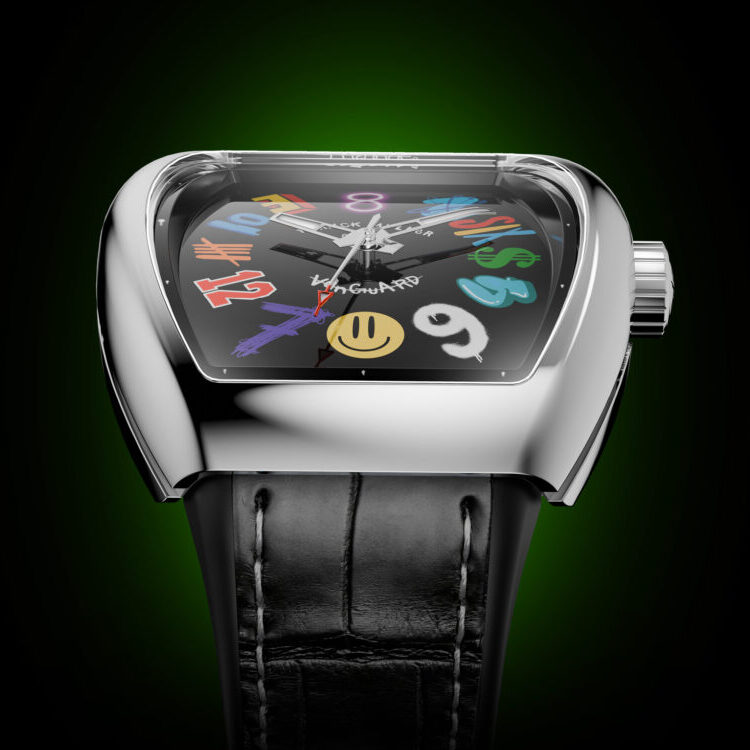
The dial is the central design argument of this watch, and it is not a simple printed surface. According to Franck Muller, 25 layers of lacquer are applied to each dial. The result is a visually dense, physically built-up surface rather than a flat graphic.
Jisbar’s approach was specific: each of the 12 hour markers was drawn from a different one of his existing paintings. The markers are not uniform in style, scale, or character — each one is a distinct visual element. Some are immediately legible as numbers; others require a moment. The dollar sign, for instance, stands in for the numeral eleven, its two vertical bars serving as the number’s structure. A smiley face represents two. The numeral three is rendered to read like the letter E. The hour markers are, in Jisbar’s own framing, fragments of a larger body of work compressed into a functional position on the dial.
The background on the men’s models is black. The two ladies’ models introduced in 2026 — a 32mm rose gold reference and a 35mm steel reference — use a white background instead, and the numeral art was updated accordingly. The ladies’ references are identified as V 32 CH JSR LTD 5N and V 35 CH JSR LTD AC.
The Crazy Hours Complication
The Crazy Hours complication, which Franck Muller first introduced in 2003, is the mechanical foundation of this collaboration. The hour markers are not arranged sequentially. Rather than running 1 through 12 in order, they follow the sequence 1, 6, 11, 4, 9, 2, 7, 12, 5, 10, 3, 8. The underlying logic is consistent: the next correct hour is always five positions ahead of the current one on the dial.
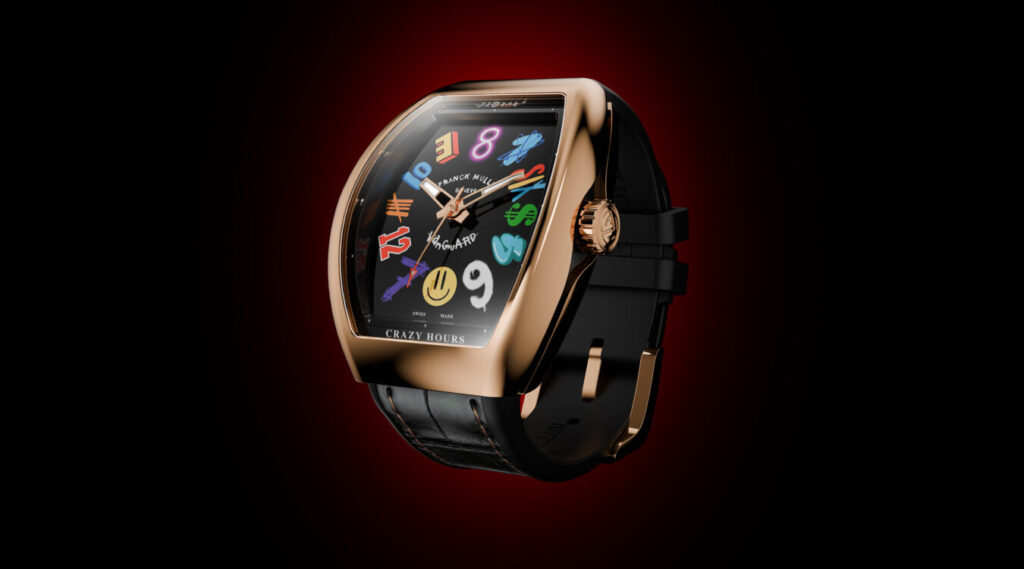
The hour hand does not sweep continuously between hours. It is a true jumping hours complication — the hand holds its position for the full duration of each hour, then advances five spaces at the top of the hour. The mechanical energy required for that jump accumulates during the hour and releases instantaneously. This is not a trivial mechanism; a standard jumping hour is already a meaningful complication, and the Crazy Hours arrangement adds a further layer of positional complexity.
Jisbar has been direct about why this complication appealed to him as a design vehicle. “You don’t buy a Crazy Hours watch to tell the time,” he has said. The complication’s resistance to at-a-glance legibility made it, in his view, a natural basis for an art project. His dial design compounds that quality rather than working against it.
The Case
The men’s model uses the 43mm Vanguard tonneau case. The case geometry — with its curved profile and hidden lugs — allows the dial to occupy a large proportion of the visual surface. Despite the 43mm diameter, the wrist-hugging curve of the case is noted as making the watch wearable across a range of wrist sizes.
Packaging and the Physical Artwork
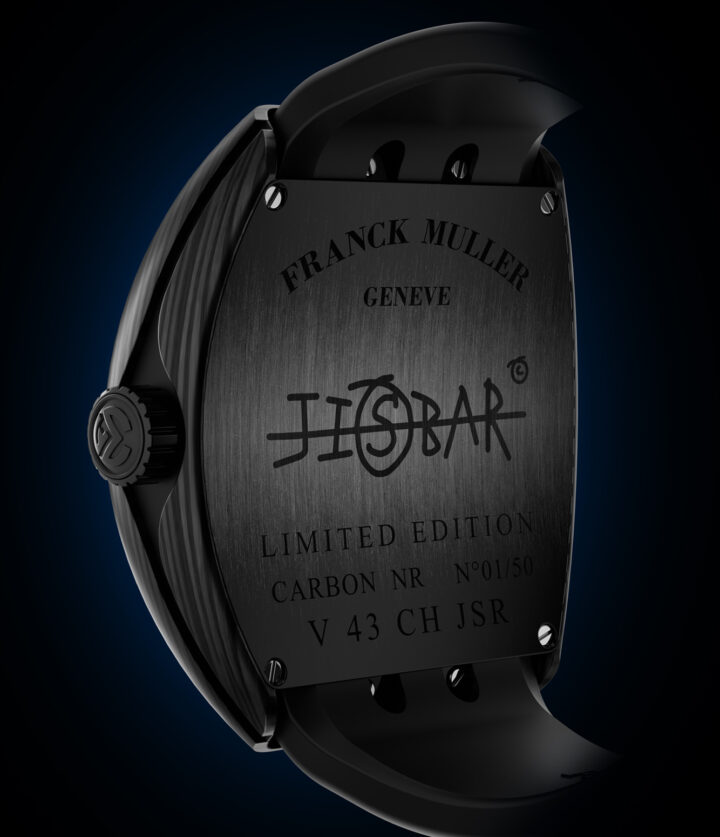
Each watch is delivered in a dedicated Franck Muller x Jisbar box. Inside that box is a fragment of an original painting on canvas. For each of the five variants, Jisbar created one original painting representing that specific watch. He then cut each painting into 50 pieces and placed one fragment in each of the 50 boxes for that variant. The 50 buyers of any single variant collectively hold the complete painting, though in practice those pieces are distributed across the world.
The concept is deliberately impractical as a reunification exercise, but it gives each watch a direct, physical connection to a unique work on canvas rather than a reproduction or a print.
Context
Jisbar had developed the dial concept independently, presenting it to multiple watch brands before Franck Muller’s Romain Urlacher agreed to proceed after seeing it at an exhibition. The brand had previously worked with artists including Eileen Chan, Loes Van Delft, Ryoko Kaneta, and Hom Nguyen, so the collaborative framework was already established. The Vanguard Crazy Hours platform, with its emphasis on visual disruption over conventional legibility, proved to be the right structural match for what Jisbar had already designed.
The ladies’ models released in 2026 extend the collaboration into smaller case sizes with revised dial artwork, confirming that the project is being developed as an ongoing line rather than a single release event.