The Bovet Récital 32 is the brand’s first watch described as a true GMT, and that designation carries real structural consequences. Bovet’s Récital series has historically been defined by vertical drama — elevated tourbillons, stacked complications, and dials that read more as architectural cross-sections than flat displays. Adding a dual-timezone function, which by its nature demands legible, laterally organised information, required the studio to make deliberate decisions about how that new layer of data would sit alongside everything else already competing for space.
The Dial as a Negotiated Space
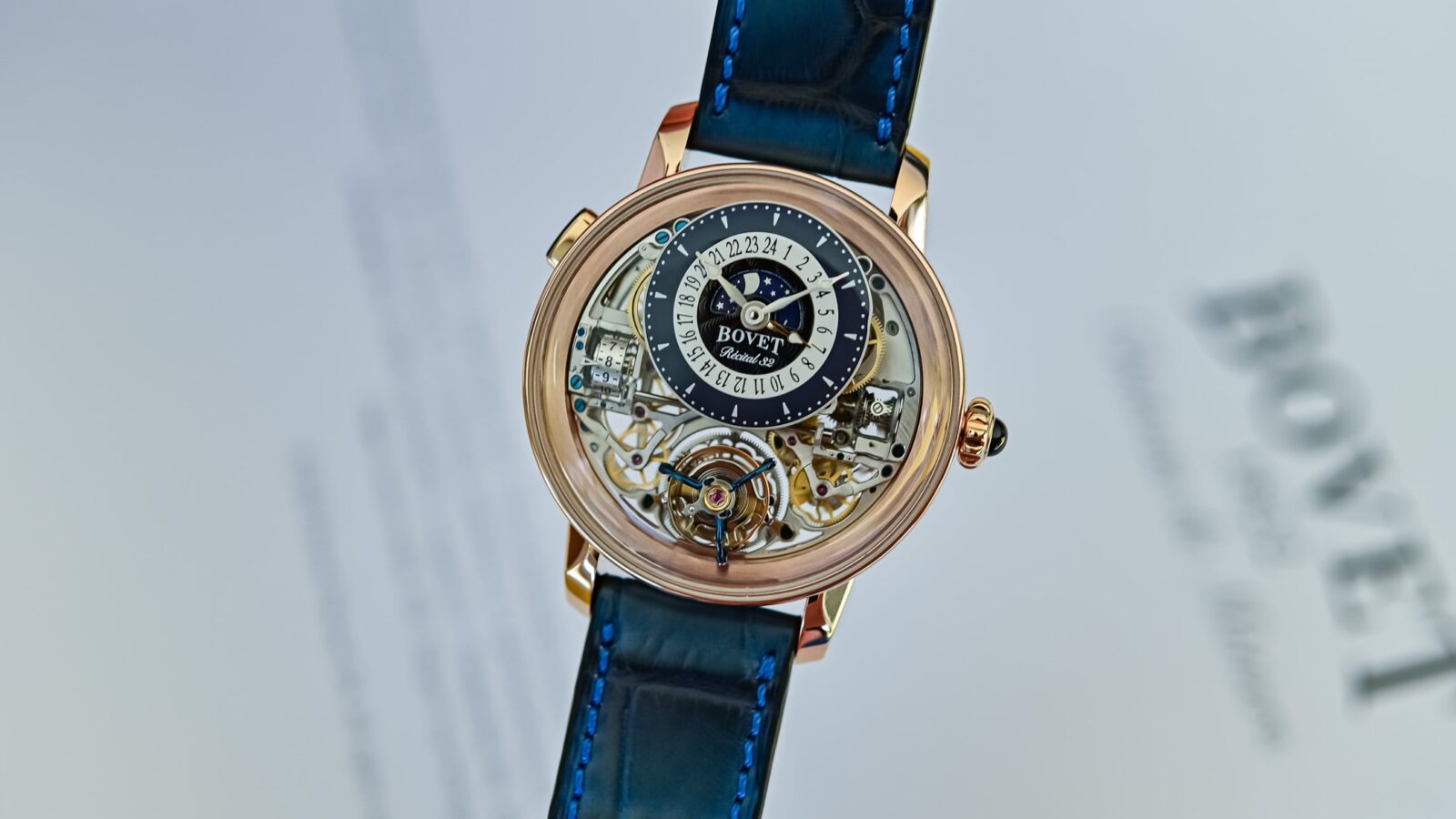
The solution Bovet arrived at is an off-centred sub-dial positioned at noon. Within that sub-dial, two distinct visual registers coexist: an outer blue lacquered track carries local time via two hands with luminescent tips, while an inner white lacquered ring running a 24-hour scale displays the second time zone via an independent GMT hand, also luminescent-tipped. At the centre of the sub-dial sits a hand-painted day/night indicator. The contrast between the blue and white lacquered zones is doing real work here — it is the primary means by which the eye separates two streams of time information occupying the same circular space.
Positioning this sub-dial at noon rather than distributing the GMT display across the full dial width is a meaningful compositional choice. It preserves the lower two-thirds of the dial for the complications that define the Récital aesthetic: the elevated flying tourbillon at 6 o’clock and the cylindrical roller power reserve indicator at 9 o’clock. The openworked construction means the hand-finished gear train, plates, and bridges are visible throughout, so the dial is not a surface so much as a transparent stage.
Verticality Preserved: The Elevated Tourbillon
The flying tourbillon sits physically above the movement plate rather than flush with it, which is the detail that most directly shapes the case architecture. To accommodate that elevation and maintain clear sightlines from multiple angles, the watch uses a panoramic box sapphire crystal. In a 42mm case, that is a considered use of the available volume — the crystal is not simply a protective cover but a structural element that makes the tourbillon’s height readable rather than obscured.
The 42mm diameter places the Récital 32 closer in scale to the Récital 30 than to the 46.3mm Récital 28. That reduction in footprint, combined with the openworked dial and rubber strap, gives the watch a more contemporary character than some earlier Récital references, without abandoning the house’s commitment to visible mechanical spectacle.
Setting the GMT: A Pusher Rather Than the Crown
The mechanism for adjusting the second time zone is worth examining on its own terms. Rather than routing GMT adjustment through the crown — which risks disturbing local time and adds wear to the winding stem — Bovet uses a dedicated pusher on the left flank of the case. The pusher advances the independent GMT hand forward in one-hour increments. The sapphire cabochon crown remains reserved for setting local time.
This separation of functions is a practical design decision with finishing implications. The pusher is a discrete element on the case flank, and its placement on the left side is deliberate — it keeps the right side of the case uninterrupted and maintains the visual symmetry of the polished titanium or 18k red gold case profiles.
Movement Construction and Finishing
The in-house movement comprises 375 components and is wound manually. A single mainspring barrel delivers a ten-day power reserve, which in a conventional configuration would require an impractical number of crown rotations to wind fully. Bovet addresses this with a patented miniature three-dimensional spherical differential that duplicates each winding action, reducing wind time and limiting mechanical stress on the gear train. The balance spring is also produced in-house.
Finishing is extensive and time-specific: hand-engraving of the plates and bridges, combined with hand-bevelling and mirror-polishing of edges, accounts for fifteen hours of work per movement. The caseback reveals a hand-engraved étoiles carrées — a square star motif — on the plates. These are not incidental decorations; they are the primary evidence of the studio’s position on what a finished movement surface should look like.
Materials and Production
The Récital 32 is available in polished titanium or 18k red gold. Each metal variant is limited to 60 numbered pieces. The watch is paired with a rubber strap, which aligns with the openworked dial’s more contemporary visual register rather than the formal leather pairings associated with some earlier Récital references. Bovet produces over 95% of components in-house, including the hairspring, the movement, and the case itself.
The Récital 32 represents a focused brief: introduce a first GMT without dismantling the visual and mechanical identity that defines the series. The off-centred sub-dial, the pusher-activated GMT hand, and the preserved tourbillon elevation suggest that brief was taken seriously at every stage of the design process. Both case variants are limited to 60 pieces each.