The Armin Strom Minute Repeater Resonance 12:59 First Edition is a direct descendant of the brand’s 2019 Masterpiece Minute Repeater Resonance, but describing it as a refinement undersells the degree of reconception involved. According to Armin Strom, almost every aspect has been reconsidered. It is, in practical terms, an entirely new watch — one whose visible architecture is inseparable from the structural problem its designers had to solve.
The Core Engineering Tension
Resonance and minute repeater mechanisms are individually among the most spatially demanding complications in mechanical watchmaking. Combining them within a single movement means reconciling two systems that compete for the same physical resources: space, acoustic transmission, and mechanical stability.
Armin Strom’s resonance system is built around a patented resonance clutch that connects two complete and independent regulating organs. Each oscillator has its own barrel, gear train, escapement, and balance wheel. A clutch spring links the two balances, allowing them to influence each other and synchronise — the effect being that positional errors are averaged out and rate stability improves. This is not a decorative arrangement. The twin-balance layout is load-bearing to the watch’s timekeeping logic, and it occupies a substantial portion of the movement’s lower half.
The minute repeater adds a striking mechanism — in this case a Westminster chime, one of the more complex variants of the complication — along with its hammers, gongs, and a flying governor. The governor regulates the speed of the striking sequence as the repeater is activated, ensuring that notes are evenly spaced and acoustically consistent. Its position beneath the hammers is not incidental; it is part of how the chiming sequence is controlled.
Fitting both systems into a case that a person might actually wear required a fundamental rethinking of how the movement’s architecture was laid out and how that layout would read visually.
What the Dial Layout Reveals
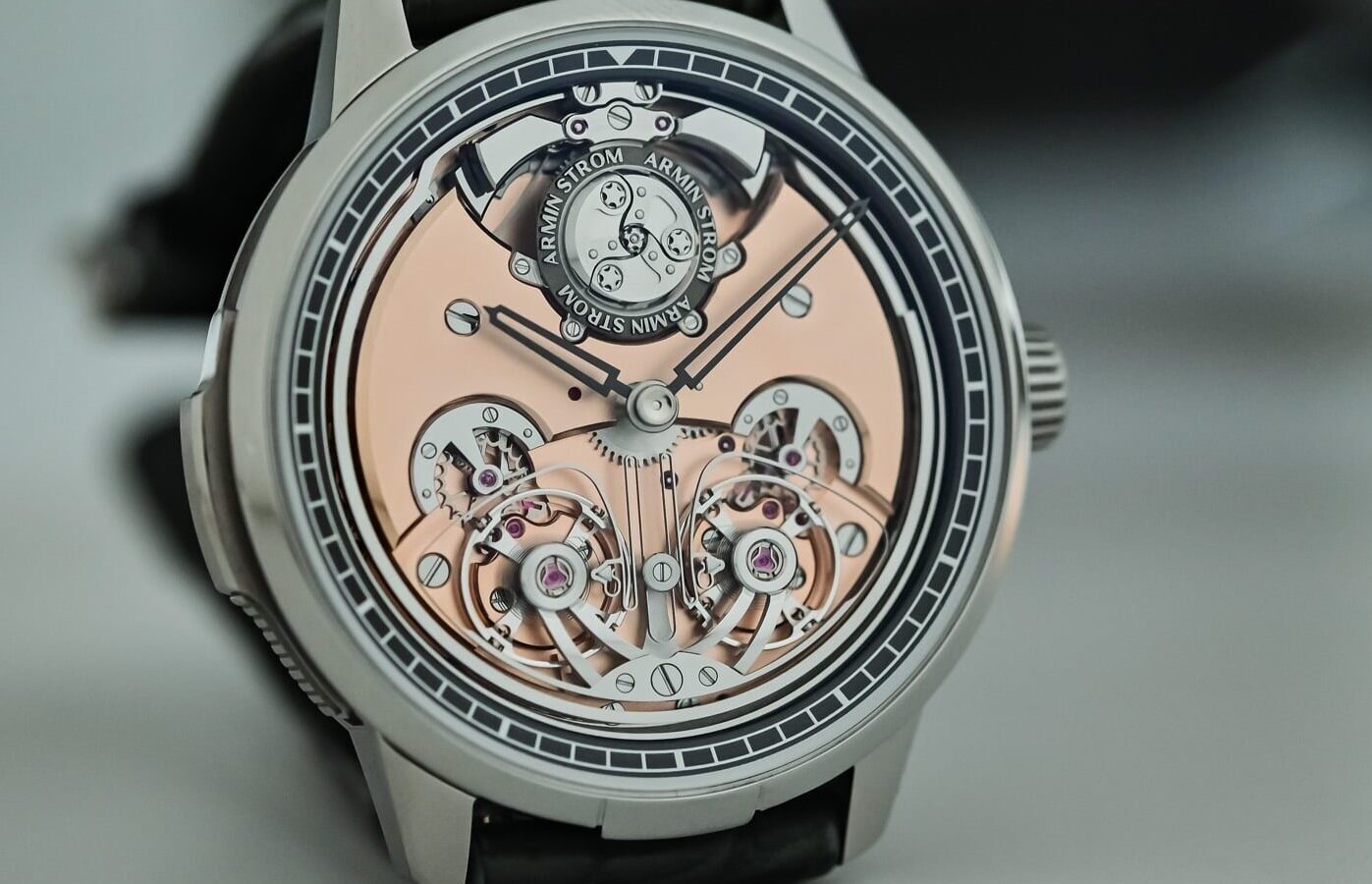
The 2019 predecessor used an off-centred subdial for time display. The new reference moves the hours and minutes to a centralised position on a suspended chapter ring. This is not a cosmetic preference. Centralising the time display freed the lower half of the movement to be occupied almost entirely by the regulation system — the twin balance wheels and their connecting resonance-clutch spring — while the upper section, at 12 o’clock, is given over to the hammers and gongs, which are fully exposed and form a symmetrical arc across that portion of the movement.
There is no conventional dial. What the wearer sees through the open architecture is the movement itself, set against what Armin Strom describes as a lightly frosted, gold-tone background — the movement plate. The mechanical components are meticulously decorated and contrast against this surface. The result is a layout where every visible element is a functional one, and the visual hierarchy of the watch maps directly onto its mechanical hierarchy: time at centre, regulation below, striking mechanism above.
Case Geometry and Material Choice
The 2019 Masterpiece Minute Repeater Resonance measured 47.7mm in diameter and 16.10mm in thickness. The new reference measures 42mm in diameter, 11.70mm in thickness, and 48mm lug-to-lug. The reduction in both footprint and profile is significant given that the movement contains 506 components.
The case material is titanium. This choice carries two direct consequences for the watch’s character. The first is practical: titanium reduces wrist weight considerably, which matters for a watch of this mechanical density. The second is acoustic. Titanium produces a sharper, higher-volume sound than gold, which tends toward a rounder, warmer tone. For a watch whose primary complication is auditory, the case material is not a neutral decision — it is part of how the Westminster chime is experienced.
Water resistance is rated at 30 metres. For a minute repeater, which requires a slide mechanism that interacts with the case and is traditionally difficult to seal, this is a meaningful specification.
The 12:59 Mode
The watch includes what Armin Strom calls a 12:59 “show off” mode. At 12:59, a minute repeater must chime the maximum possible sequence — twelve hours, four Westminster quarter-chime sequences, and fifty-nine minutes — making it the longest and most complete demonstration of the striking mechanism’s range. The inclusion of a dedicated mode for this moment is, as Armin Strom acknowledges, a deliberate indulgence rather than a functional necessity. It exists to let the owner demonstrate the full capability of the chiming system on demand.
A More Considered Execution
The Minute Repeater Resonance 12:59 First Edition is a more considered object than its predecessor in measurable terms: smaller, thinner, lighter, and acoustically shaped by its case material. The open architecture is not a stylistic gesture but a direct consequence of fitting two mechanically competing systems into a single movement and making that coexistence legible. Whether the 12:59 mode reads as a charming eccentricity or an unnecessary flourish will depend on the wearer — but the structural decisions that surround it are entirely serious.