Van Cleef & Arpels introduced the Jour Nuit collection in 2008 as a vehicle for translating the 24-hour cycle into dial architecture. The collection was extensively updated in 2024, and the Midnight Jour Nuit Phase de Lune, announced in 2026, represents its most mechanically complex iteration to date. It adds a moon phase complication and an on-demand automaton to the existing day/night display, and the case has grown from the original 33mm and 38mm sizes to 42mm in diameter to accommodate the additional mechanical content.
The Dial as a Layered Celestial Map
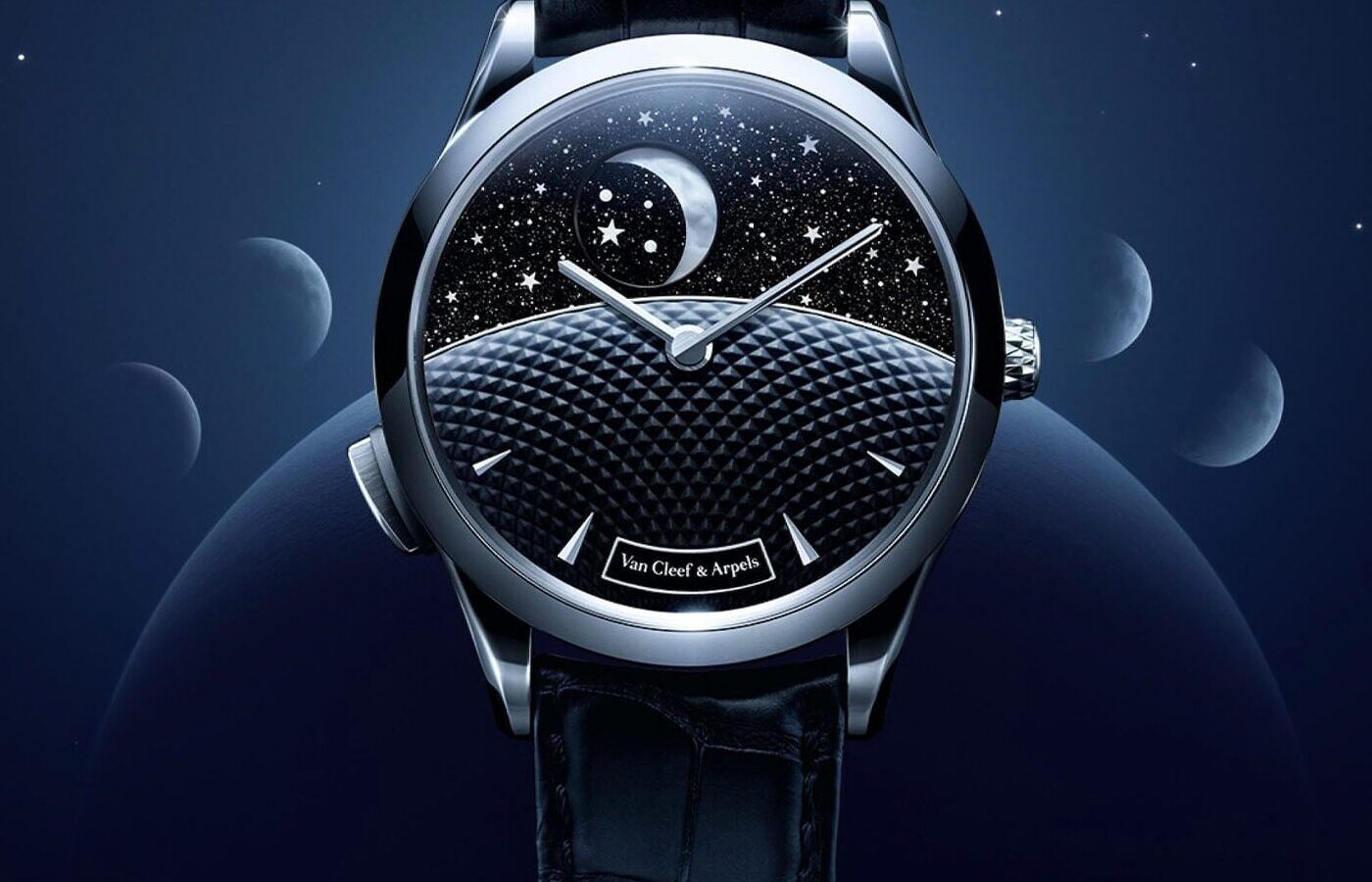
The dial is divided horizontally into two distinct zones, and the logic of that division is both narrative and functional. The upper half is occupied by a custom-made black Murano aventurine glass disc. This material was produced specifically for Van Cleef & Arpels and contains bronze-toned crystalline inclusions that produce a glittering, depth-rich surface — a considered choice for a sky that must read convincingly across a range of lighting conditions.
Mounted on this upper disc are two principal indicators: a yellow gold sun with guilloché finishing and a white mother-of-pearl moon accompanied by small stars. These travel on a 24-hour rotating disc, marking the progression from day to night. The guilloché on the sun is not decorative in isolation — it catches light differently as the disc rotates, giving the indicator a quality of luminosity that a plain polished surface would not achieve.
Cut directly into the aventurine is a round aperture. Through it, a second, lower disc is visible, tracking the moon’s 29.5-day synodic cycle. The aperture is the structural solution to a genuine design constraint: the moon phase disc must be legible without disrupting the visual continuity of the aventurine sky. By recessing the second disc beneath the first and revealing it only through the aperture, the two complications share the same visual plane without competing for surface area.
The Lower Dial and the Horizon
The lower half of the dial is crafted from mother-of-pearl worked with a Clous de Paris guilloché pattern. A hand-painted gradient transitions from black where it meets the aventurine sky to white at the lower edge, functioning as a horizon line. The gentle curve of this section reinforces the horizon reading and creates a subtle three-dimensionality within the dial plane.
Hour and minute hands are faceted baton-style. Four applied white gold hour markers are placed on the dial, with a VCA cartouche positioned at 6 o’clock. The restraint here is deliberate: the dial carries significant visual complexity in its upper section, and a heavily indexed lower half would compete with it rather than support it.
The Automaton: Four Years of Development
The most technically demanding element of the Midnight Jour Nuit Phase de Lune is the on-demand moon phase display. A pusher positioned at 8 o’clock on the case flank activates an automaton that rotates the entire dial 360 degrees over ten seconds, revealing the precise current state of the moon’s waxing or waning cycle. This functions independently of the ambient light conditions — the moon phase is visible even in full daylight, which the standard aperture-based display cannot guarantee.
Van Cleef & Arpels states that four years were required to develop this on-demand animation. The central engineering requirement was that activating the automaton must not compromise timekeeping accuracy — the movement continues to run correctly through the rotation. That constraint shapes the entire mechanical architecture of the complication module.
Case, Movement and Finishing
The 42mm case is executed in 18k white gold, rhodium-plated, with a combination of polished and brushed surfaces. There are no diamonds on this reference. Water resistance is rated to 30 metres. The caseback is white gold, engraved with the topography of the lunar surface. A sapphire crystal is set over the rotor, and beneath it the rotor is decorated with miniature paintings of three planets and the Earth at the centre — a continuation of the cosmic narrative that runs through the entire piece.
The movement is an in-house automatic calibre with a 36-hour power reserve. It carries the day/night display, the 29.5-day moon phase indication, and the on-demand automaton function. The watch is fitted on a black satin-finished alligator strap with a white gold folding buckle.
Design Assessment
What the Midnight Jour Nuit Phase de Lune demonstrates is the difficulty of integrating multiple complications into a dial that is also a jewellery object. The aventurine aperture, the horizon gradient, the guilloché sun, and the automaton pusher each solve a specific problem — legibility, material continuity, light interaction, and on-demand display — without visibly advertising their function. The case enlargement from the earlier Jour Nuit sizes to 42mm is a direct consequence of the added mechanical content, not an aesthetic preference. The reference is catalogued under Van Cleef & Arpels’ Poetic Astronomy designation, reference VCARPESA00.