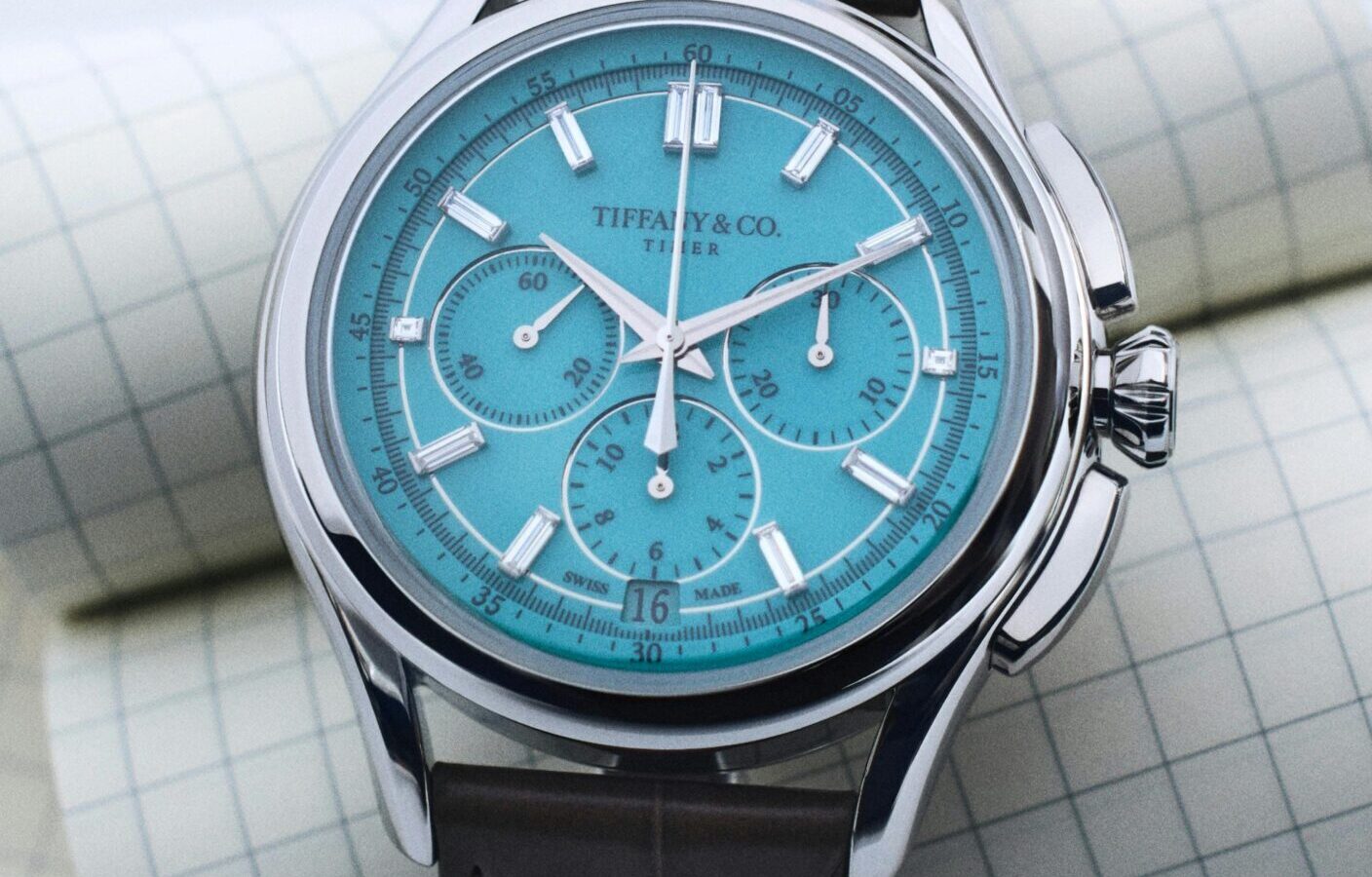
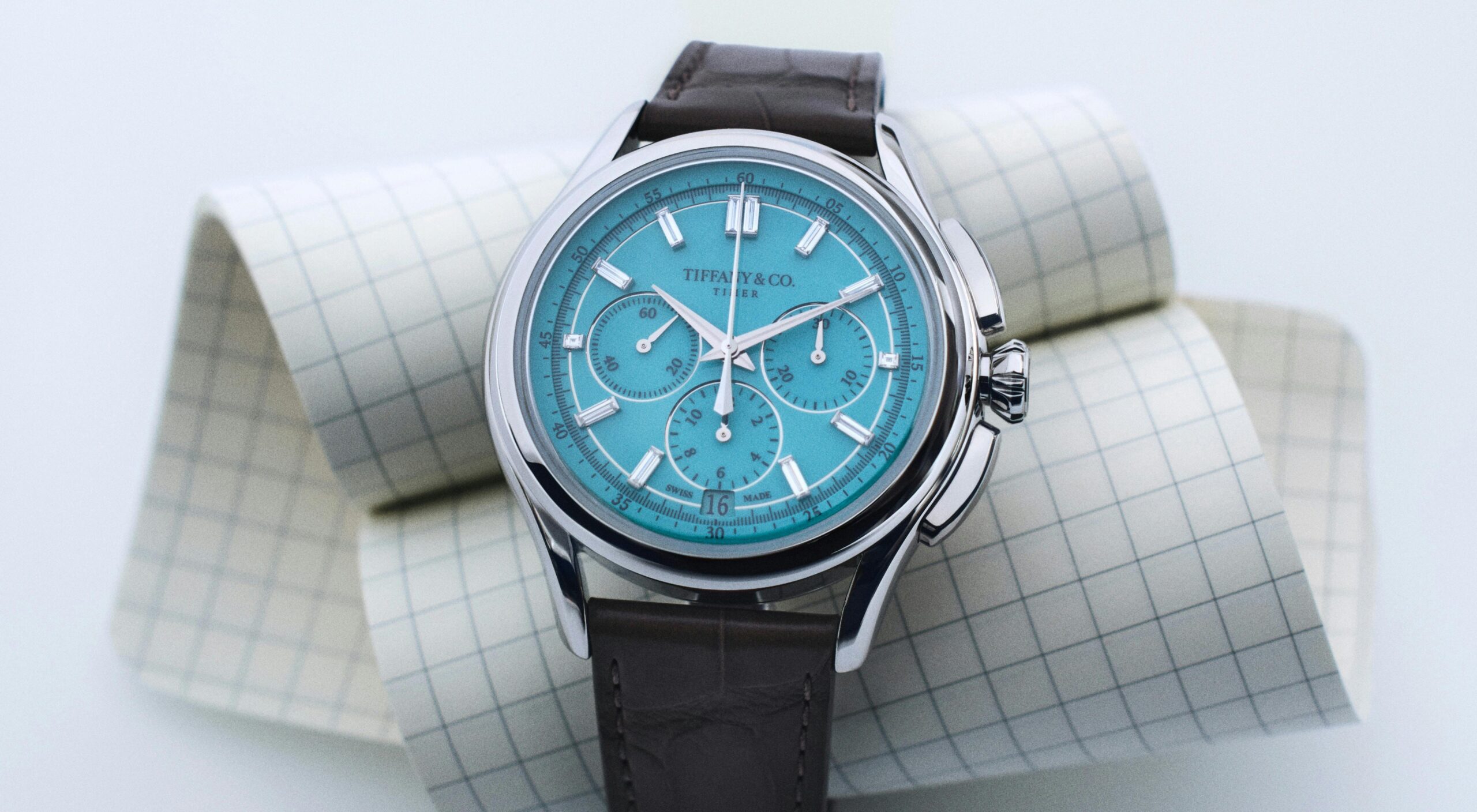
The Tiffany Timer chronograph arrives in a platinum case with a dial set in baguette-cut diamonds. That combination alone signals the design intent clearly: this is a chronograph conceived from within a jewelry house’s vocabulary, not adapted toward one after the fact. Understanding what that means in practice requires looking at the design decisions embedded in the case, the dial, and even the crown — and at the transatlantic history that made those decisions legible.
Tiffany & Co.’s relationship with watchmaking is frequently reduced to its role as a retailer — the co-signed dial, the authorized partner. The actual history is more structurally interesting. By 1874, Tiffany had invested in a manufacturing facility in Geneva, operating it at a scale that, as Nicolas Beau, Tiffany’s Vice President of Horlogerie, notes, made the American house “one of the largest in Geneva at a time when many of today’s Swiss pillars were still small mountain workshops.” When that facility was sold to Patek Philippe in 1878, the transfer formalized a relationship that had already been codified: a formal agreement signed in 1876 and running through 1881 designated Tiffany & Co. as “general agents in America for Patek, Philippe & Co.”, with Tiffany committed to attending to Patek’s American interests “as if it were their own.”
That New York–Geneva axis is not incidental to the Timer’s design brief — it is the brief. The watch marks the 160th anniversary of Tiffany’s first timing watch, a pocket stopwatch issued in 1866. Rather than reissuing a single archival reference, the design team drew from several historical sources, including two split-seconds chronographs bearing “Geneva” on the dial. The Timer is a composite, not a replica.
Chronograph Architecture Filtered Through Jewelry Priorities
The decision to build a chronograph rather than a dress watch or a complication more associated with jewelry carries its own logic. Beau is direct about the category tension: “We are not a sports watch brand. This chronograph had to be the chronograph of a jeweler.” That framing shapes every formal decision in the watch.
The case material is platinum. For a jewelry house, this is not an unusual choice — Tiffany has worked platinum extensively in high jewelry — but in the context of chronograph design, where steel and gold dominate, it positions the Timer outside the utilitarian tradition of the category. Platinum’s density and its particular surface quality under finishing distinguish it visually and materially from both steel sports chronographs and conventional gold dress watches.
The dial is set with baguette-cut diamonds. The baguette cut, with its clean rectangular geometry and step-cut faceting, is a natural fit for dial architecture: it reads as structured and precise rather than decorative in a soft or floral sense. Critically, Beau frames these elements not as embellishment applied to a watch but as natural features for a watch being made by a jeweler. The distinction matters to the design reading. The diamonds are not a finish; they are part of the dial’s primary architecture.
The Crown as Jewelry Reference
One detail in the Timer’s design is worth examining closely: the crown. Its form echoes the six-prong Tiffany Setting, the configuration used in the house’s diamond solitaire rings. Translating a ring setting’s geometry into a functional watch component is a precise kind of cross-disciplinary design thinking. It is not a decorative motif borrowed loosely from the jewelry archive; it is a specific structural form — the prong arrangement — reinterpreted at a different scale and in a different functional context. The result is a crown that reads as continuous with the watch’s jewelry identity rather than as a separate mechanical element.
What the Historical Record Contributes to the Design Reading
The Timer’s design language gains additional coherence when set against Tiffany’s broader horological history. The house’s own mainline watch production paused during the 1930s and did not fully recover until the 1980s. In the intervening decades, Tiffany remained present in watchmaking primarily as a retailer — selling pieces from Rolex, Patek, IWC, Movado, and others — while its co-signed dials accumulated their own cultural weight.
Beau’s answer, as expressed through the Timer, is that it should look like something made by a jeweler: platinum, baguette diamonds, a crown drawn from the solitaire setting. The chronograph function provides the instrument’s structure; the jewelry craft provides its formal identity. The two are not in tension in this design — they are the design.
The Timer is currently available through Tiffany & Co. The watch represents the house’s most direct statement yet on what its watchmaking identity looks like when jewelry craft and chronograph architecture are treated as a single design problem rather than two separate disciplines brought into proximity.