Bulgari introduced its Aluminium collection in 1998, pairing an aluminium case with a rubber bezel at a time when aluminium remained an unusual choice for a watch case rather than a lighter component such as a bezel. The collection was refreshed in 2020 with mechanical automatic movements, improved water resistance, aerospace-grade aluminium and reshaped lugs. For summer 2026, Bulgari returns to the 40mm time-and-date configuration with two new dial treatments: Ice Blue and White. The Ice Blue reference is limited to 500 pieces; the White is not limited.
What the Material System Allows — and Doesn’t
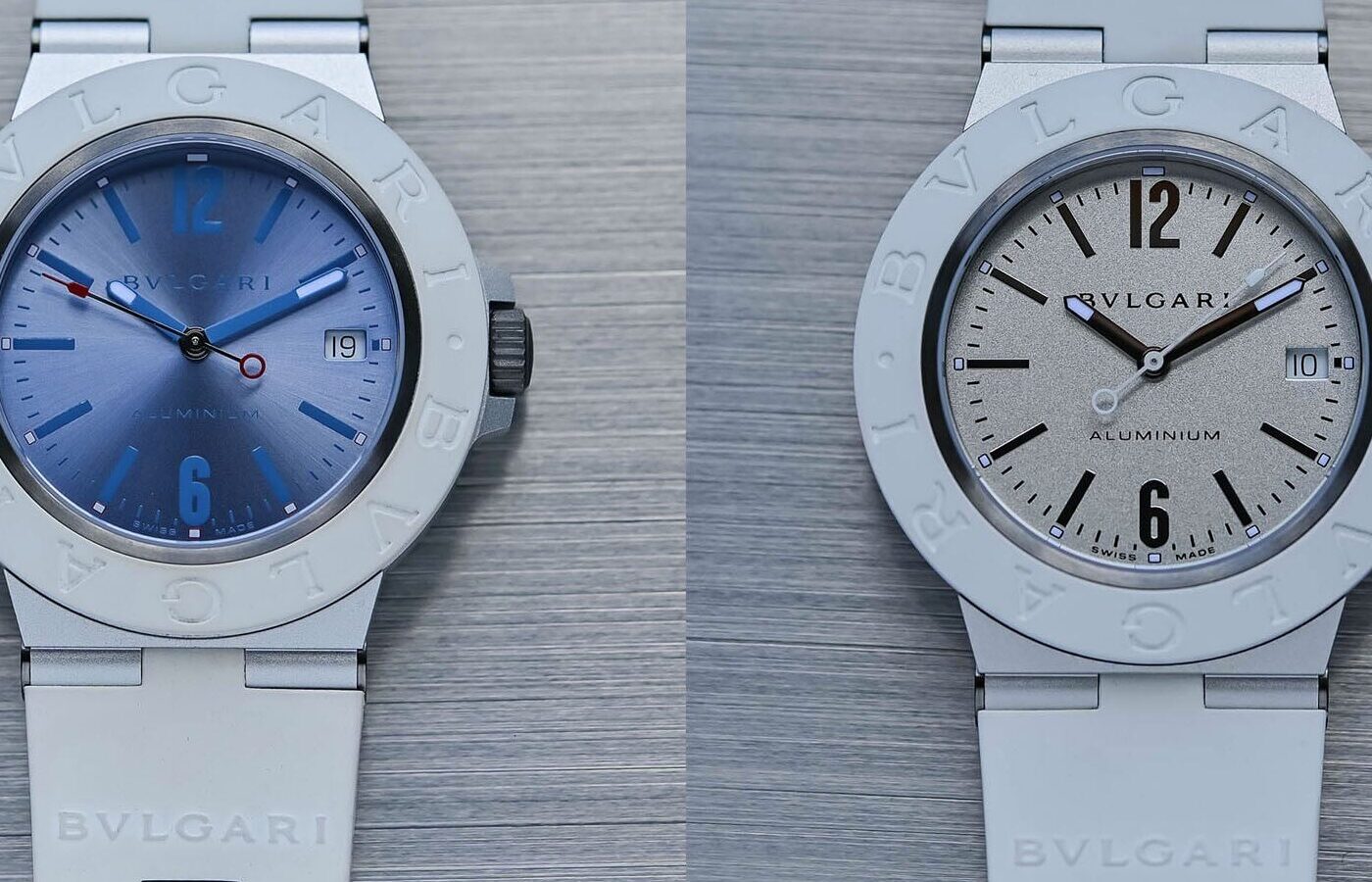
The Aluminium’s case construction is the starting point for any colour decision made on the dial. The case is sandblasted aluminium, 40mm wide and 9.4mm thick, with a titanium caseback and crown. The bezel and integrated strap are rubber. On these summer references, both the bezel and strap are white — a deliberate seasonal shift from the collection’s signature black rubber. The white rubber bezel carries the double Bulgari signature engraving, consistent with the line’s identity since its original launch.
Aluminium and rubber share a particular surface quality: both are matte or near-matte in their natural state, and neither offers the depth of reflection that polished steel or ceramic provides. The sandblasted finish on the case reinforces this. A colour strategy that relies on high-contrast gloss or deep chromatic saturation would read differently against this material combination than it would against, say, the ceramic and polished titanium of the Octo Finissimo family. The Aluminium’s surfaces absorb rather than amplify colour, which means the dial must carry the visual work more directly.
Ice Blue: Colour as the Primary Finishing Technique
The Ice Blue dial uses a sun-brushed finish — radiating lines that catch light differently depending on viewing angle. Against the matte white rubber surround, this creates a contrast in surface behaviour rather than in tone alone. The dial’s large Arabic numerals at 12 and 6 o’clock, along with the baton markers, are coated in blue varnish. The hour and minute hands receive the same blue varnish treatment, with Super-LumiNova inserts at their tips. The central seconds hand is sandblasted and carries a red lacquered tip with a circular counterweight.
The decision to varnish the indices and hands in blue rather than apply a metallic finish is significant from a design standpoint. Varnish is opaque and flat; it does not reflect the surrounding case or dial surface back at the viewer. On a watch where the case material itself is low-reflectivity, this consistency of surface behaviour across dial, indices and hands produces a coherent visual register. The red tip on the seconds hand is the single chromatic departure — a small but deliberate accent that prevents the composition from becoming static.
The Ice Blue reference is limited to 500 pieces, which distinguishes it from the White variant within the same seasonal release.
White: Restraint as a Design Position
The White opaline dial takes a different approach. Opaline is a smooth, non-directional finish — it does not catch light the way a sun-brushed surface does. Where the Ice Blue dial uses colour to create hierarchy among its elements, the White dial relies on material contrast: rhodium-plated indices and hands against the opaline ground. Rhodium plating produces a cool, bright metallic surface, and against white opaline it reads as a tonal rather than chromatic contrast.
The central seconds hand on the White reference has white lacquered accents rather than red, keeping the palette strictly monochromatic. Super-LumiNova inserts appear on the tips of the hour and minute hands, as on the Ice Blue. The date aperture sits at 3 o’clock on both references.
The effect is a dial that places its confidence in proportion and finish rather than colour. Given that the surrounding case and strap are already white rubber, the White opaline dial extends a single-tone logic across the entire watch — case, bezel, strap and dial surface all operating within the same narrow value range.
Movement and Construction
Both references are powered by calibre B77, which uses a Sellita SW300 automatic base. The movement beats at 28,800 vibrations per hour and delivers a 42-hour power reserve. It is positioned beneath the titanium caseback rather than displayed through a display back. The watch is rated to 100 metres of water resistance.
The integrated rubber strap incorporates central sandblasted aluminium links, which serve both an aesthetic and a functional purpose: they articulate the strap while maintaining visual continuity with the sandblasted aluminium case. Attachment is via a classic pin buckle.
Seasonal Design Within a Fixed System
What these two references demonstrate is how a brand can pursue seasonal variation within a material system that does not change. The aluminium case, rubber bezel and integrated rubber strap are fixed elements of the Aluminium collection’s identity. The dial and the bezel colour are the variables. Switching the bezel and strap from black to white, and then differentiating two dials through finish type, hand treatment and chromatic accent, produces two watches that read as summer pieces without altering the underlying construction.
The Ice Blue edition’s 500-piece limitation and the White’s open production run suggest Bulgari is treating the two differently in terms of market positioning, even though they share the same case, movement and strap configuration.