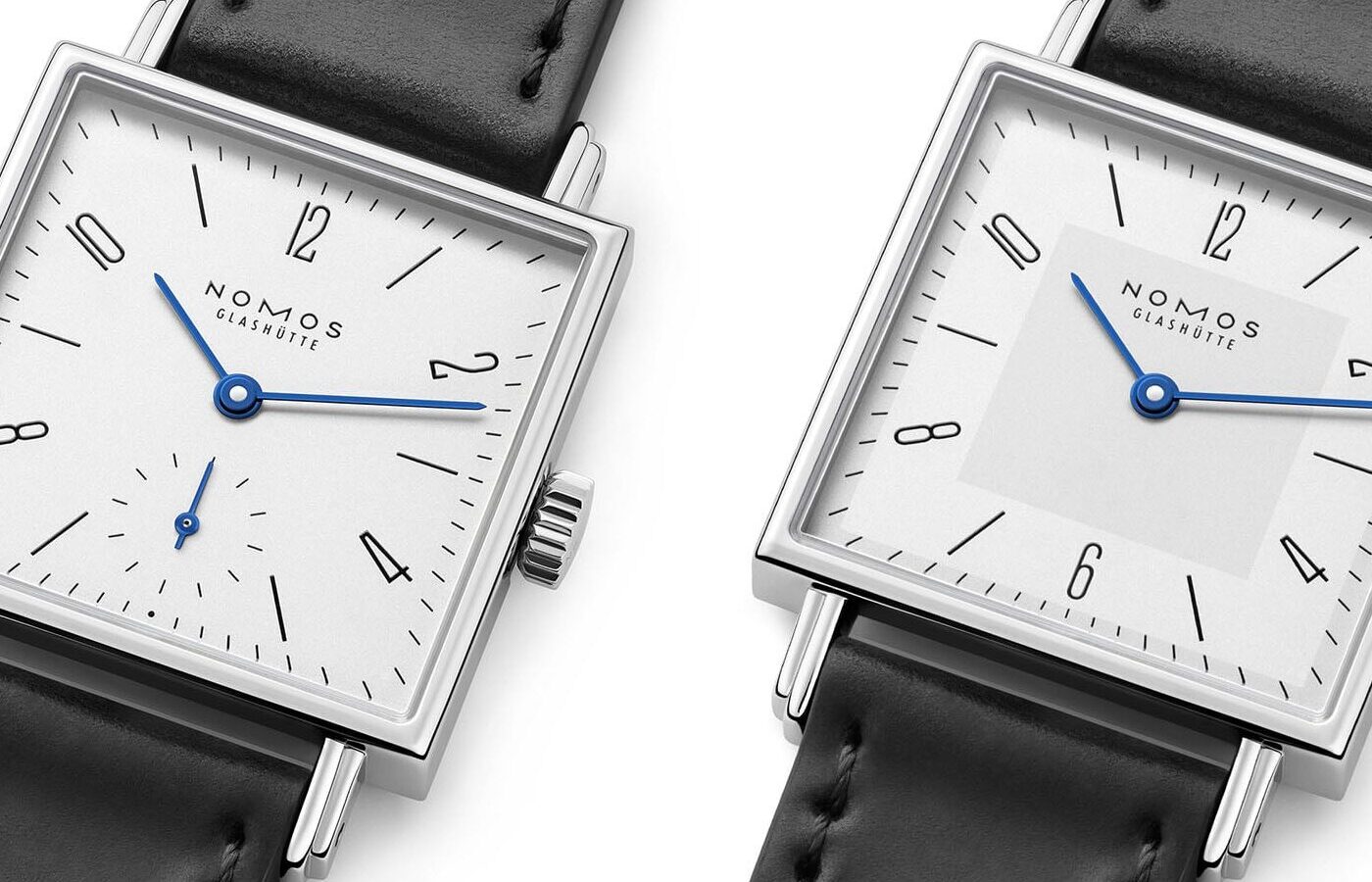
Nomos has added two new references to its Tetra 27 line: the Tetra 27 white and the Tetra 27 duo. Both share a square stainless steel case measuring 27.5mm × 27.5mm with a thickness of 6.1mm. That is a small footprint by any standard, and the design decisions required to make a dress watch function coherently at that scale are worth examining in detail.
Why Square Geometry Changes the Sizing Conversation
The Tetra 27 is not simply a round watch made smaller. Square geometry carries a different visual weight than circular geometry at equivalent widths. A round watch covers roughly 78% of the surface area of a square watch at the same stated dimension—a fact Nomos has acknowledged directly in discussing the Tetra line. This means a 27.5mm square case presents more dial surface than a 27.5mm round case would, and that additional surface area is not a luxury; it is a design problem. Every element placed on it must justify its position within a tighter, more geometrically rigid frame.
The double-stepped lugs on the Tetra 27 reinforce this geometry. Rather than softening the transition between case and strap, they articulate it, adding a layered, architectural quality that is consistent with the Art Deco references implicit in the square form. The case is fully polished, which at this scale means the finishing must be precise—any inconsistency in the polished surfaces reads immediately on a bezel this narrow.
Dial Composition at Miniature Scale
The Tetra 27 white carries what Nomos describes as its most classic dial configuration: a silver-plated, galvanised white dial with black printed Arabic numerals and markers, blued steel hands, and a small seconds sub-dial. The numerals and markers are shared with the Tangente, Nomos’s long-running round dress reference. Transplanting that typographic system into a square format 27.5mm across is not a neutral act. The same letterforms and index weights that read comfortably on a larger round dial must now coexist with the hard corners of the square chapter ring and the geometric discipline of the case itself.
One specific departure from the existing hand-wound Tetra in 29.5mm is worth noting: the Tetra 27 white uses a flat, round small seconds sub-dial rather than the recessed square sub-dial found on the older reference. This is a meaningful compositional choice. A recessed square sub-dial within a square case creates a nested geometry that can feel busy at reduced scale. A flat, round sub-dial introduces a contrasting form—circle within square—that gives the eye a point of relief without adding visual complexity.
The Duo Dial: Negative Space as Structure
The Tetra 27 duo takes a different approach to the same constraints. It is a two-hand-only model—hours and minutes, no small seconds—and its galvanised dial uses a two-tone treatment: a light grey square at the centre, with a matching grey field framing the minute track. The white and grey silver-plated zones are both galvanised, so the tonal contrast is subtle rather than graphic. Removing the seconds hand eliminates one layer of information from the dial, and the two-tone layout uses that freed space deliberately, creating a visual hierarchy through tone rather than through additional elements.
This two-tone configuration existed previously in a 29.5mm version with small seconds. Bringing it to the 27.5mm format without the seconds complication produces a cleaner result: the grey centre square reads as a field of negative space, and the grey minute-track border gives the dial a defined perimeter without requiring printed indices at every position.
Movement Architecture and Finishing
Both references run the hand-wound Calibre DUW 4001, with the duo variant designated DUW 4001 duo to reflect the absence of the small seconds function. The movement measures 23.3mm × 2.6mm and beats at 21,600 vibrations per hour, with a power reserve of 53 hours and 17 jewels. It is an evolution of the Alpha calibre, which itself descends from the Peseux 7001, though the current execution is substantially different: the bridges have been redesigned as a three-quarter plate, and the decoration includes Glashütte ribbing, perlage, a double-sunburst ratchet wheel, and blued screws. The escapement is in-house, fitted with Nomos’s own blue balance spring produced through the brand’s Swing system.
The Tetra 27 white includes a stop-seconds function; the duo does not. The caseback is available in either solid steel or sapphire crystal, the latter making the movement decoration accessible without altering the external case geometry. Water resistance is rated at 50 metres.
Strap and Proportional Finish
Both watches are fitted on a black Horween Genuine Shell Cordovan strap with an 18mm lug width and a steel pin buckle. Shell Cordovan is a dense, fine-grained leather that wears slim and develops a surface patina over time—an appropriate material choice for a watch this thin, where a bulky strap would disrupt the proportional balance the case geometry establishes.
The Tetra 27 white carries reference number 402; the Tetra 27 duo is reference 410. Both enter the permanent collection.