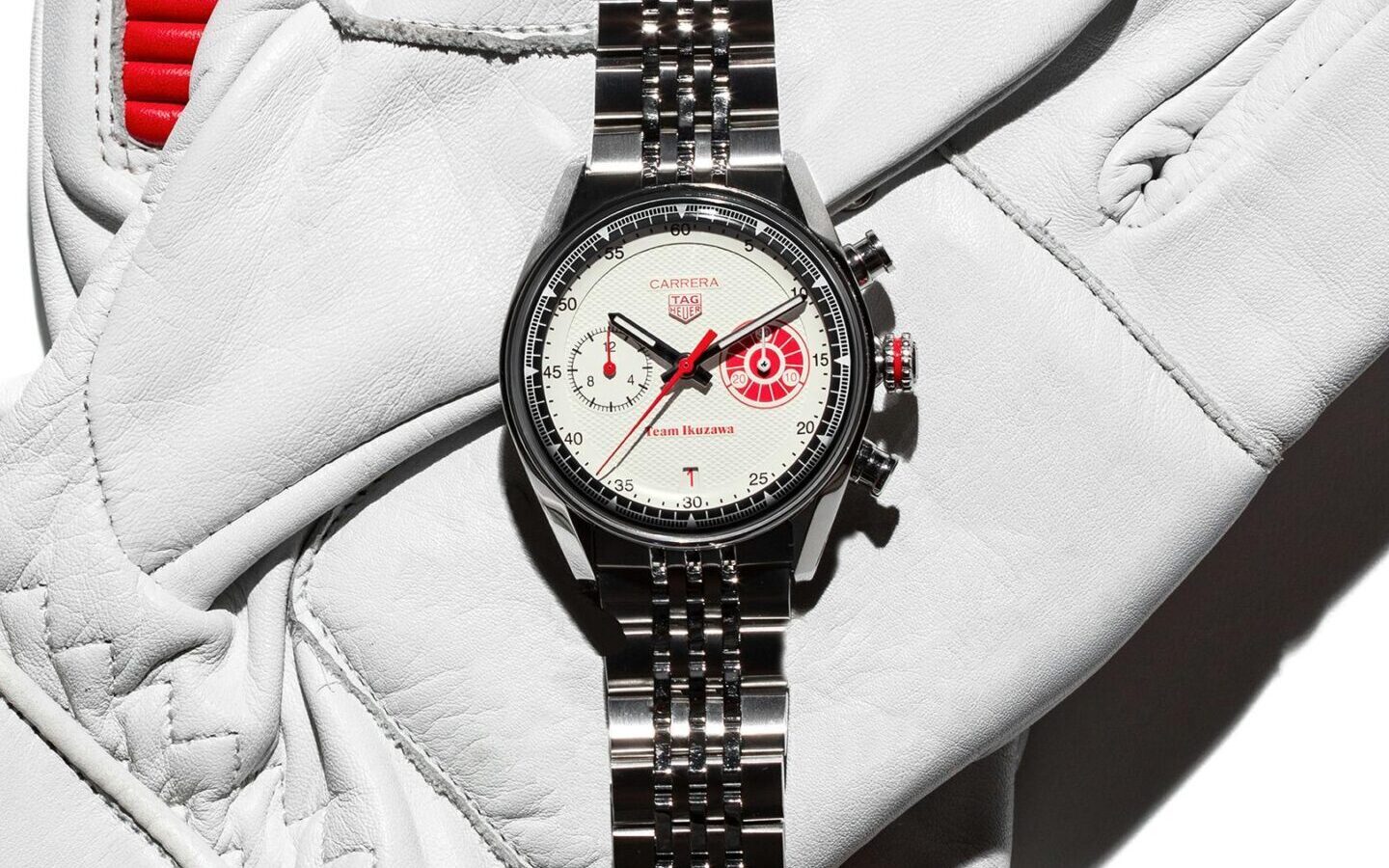
Three years after the original 42mm Carrera Chronograph x Team Ikuzawa by Bamford, TAG Heuer has released a second edition of the collaboration, this time built around the 39mm Carrera Glassbox Chronograph. The reference CBS221M.EB0435 is limited to 150 pieces and brings together TAG Heuer, Team Ikuzawa — the racing team founded by Japanese driver Tetsu Ikuzawa — and Bamford Watch Department for a second time. The move to the Glassbox platform is not cosmetic. It changes the proportions, the crystal geometry, and consequently the way the dial’s red-and-white colour language reads at a distance and up close.
The Glassbox Format and What It Does to Proportion
The Carrera Glassbox Chronograph was introduced in 2023, reviving the proportions and legibility of the original Carrera while replacing the conventional bezel with a domed sapphire crystal that extends over a sloping flange. The result is a case that measures 39mm in diameter, 13.9mm in height, and 46mm lug-to-lug. Against the original collaboration’s 42mm case, the reduction is 3mm in diameter — enough to shift the visual weight of the watch considerably and to alter how much dial surface is visible relative to the case edge.
Without a raised bezel interrupting the transition from crystal to case, the domed sapphire draws the eye inward and downward across the flange before settling on the dial. The flange itself is finished in black, which creates a clean boundary between the crystal’s curvature and the white dial field. That boundary matters here because the Team Ikuzawa colour language — red and white — depends on contrast for its legibility. The black flange provides a neutral frame that prevents the white dial from bleeding visually into the case.
Dial Architecture: Printed Indices and the Stopwatch Reference
The dial is finished in white with a Clou de Paris texture. Where the standard Carrera Glassbox uses applied hour indices, this edition replaces them with printed markings, a deliberate reference to the stopwatch aesthetic of Team Ikuzawa’s Roadmaster timing instruments from the 1970s and 1980s. The decision to print rather than apply is consequential: applied indices add physical relief and cast micro-shadows under the domed crystal, while printed markings keep the dial surface flat and graphic. Under the Glassbox crystal’s curvature, that flatness reads differently than it would under a flat sapphire — the dome introduces a slight optical magnification at centre that makes the printed elements appear crisper than their physical scale would suggest.
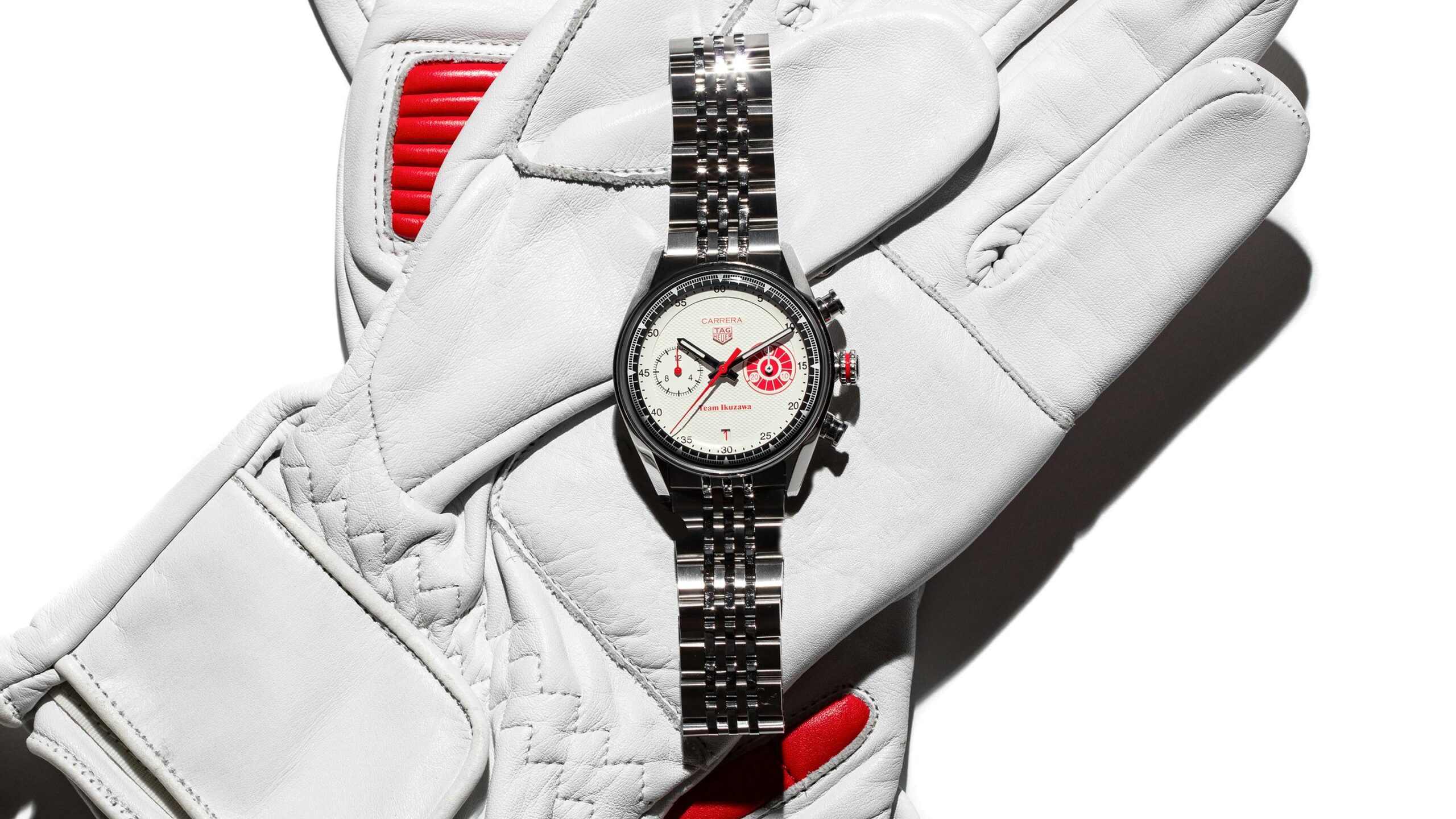
The layout is bicompax: a 30-minute chronograph counter at 3 o’clock and a 12-hour counter at 9 o’clock. There is no running seconds subdial, which clears the lower half of the dial for the Team Ikuzawa signature above the date window at 6 o’clock. The tachymetre scale is absent. This restraint in the subdial count — two registers rather than three — is consistent with vintage Heuer racing chronographs that reserved dial space for team identification rather than maximising complication display.
Red as a Structural Element
Red appears with unusual consistency across the dial. The hour and minute hands carry red lacquer; the central chronograph seconds hand is red; the date wheel numerals are printed in red; the crown at 3 o’clock has a red lacquered ring; and the Team Ikuzawa logo at 6 o’clock is rendered in red. The rhodium-plated, facetted hour and minute hands are noted as polished with red lacquer and white SuperLuminova, which means the red is present even in low-light conditions where luminous material typically dominates.
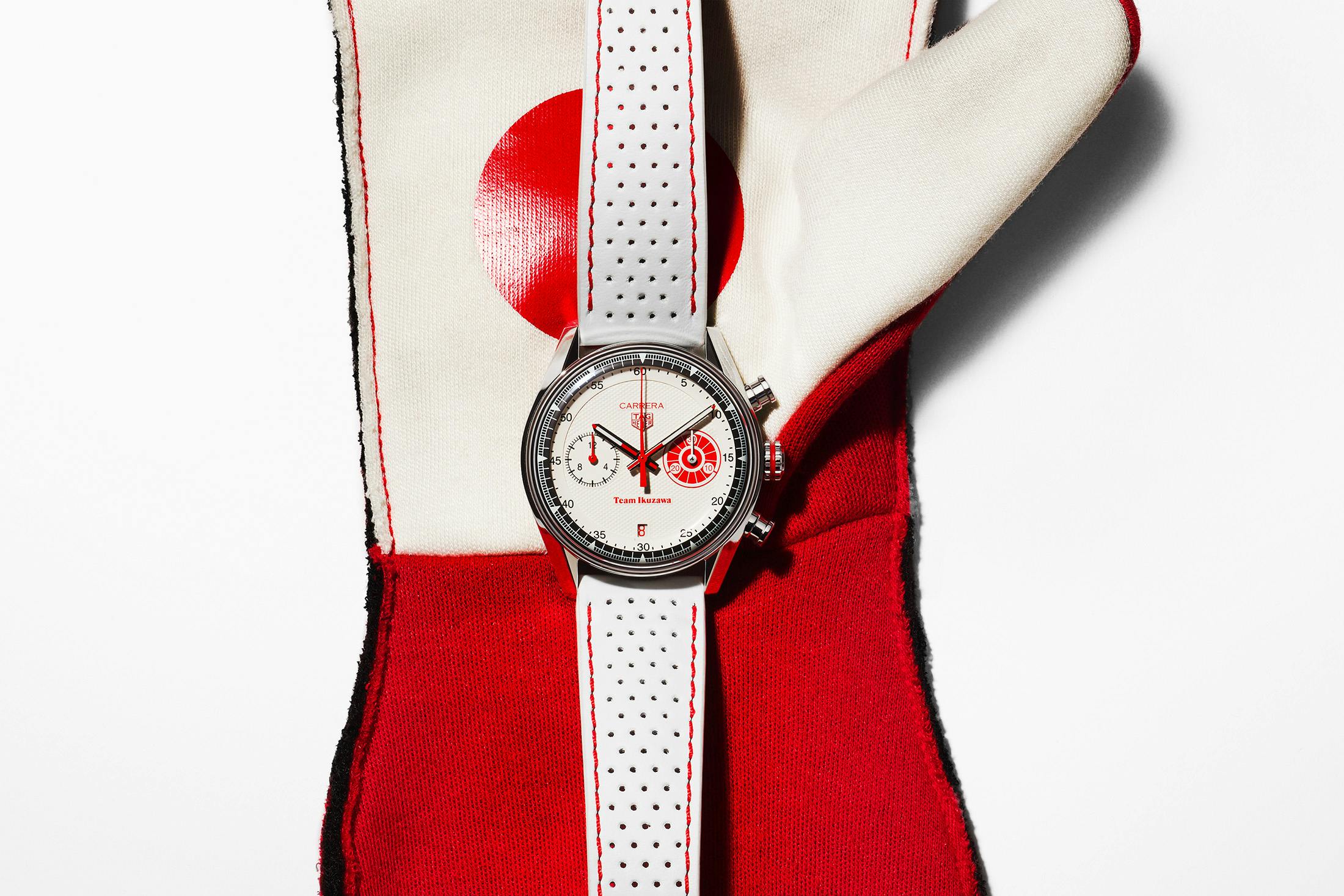
On a 42mm dial, this density of red accents would distribute across a larger field and risk reading as decorative. On the 39mm Glassbox dial, the tighter geometry concentrates those accents, and the printed — rather than applied — indices keep the surface from becoming visually crowded. The white Clou de Paris texture adds a fine-grain diffusion that softens the white ground without dulling it, allowing the red elements to remain the primary visual event.
Case Finishing and Construction
The stainless steel case combines brushed and polished surfaces. The crown is screw-down with a red lacquered ring, and the pushers are described as vintage-style. Water resistance is rated to 100 metres. The caseback is sapphire, carrying engravings from Team Ikuzawa and Bamford Watch Department alongside the individual piece number.
Movement
The watch is powered by the manufacture calibre TH20-10, an automatic chronograph movement operating at 4Hz with an 80-hour power reserve. It uses a column wheel and vertical clutch, with a bi-directional winding system. The movement displays hours, minutes, chronograph hours and minutes, and date.
Straps and Presentation
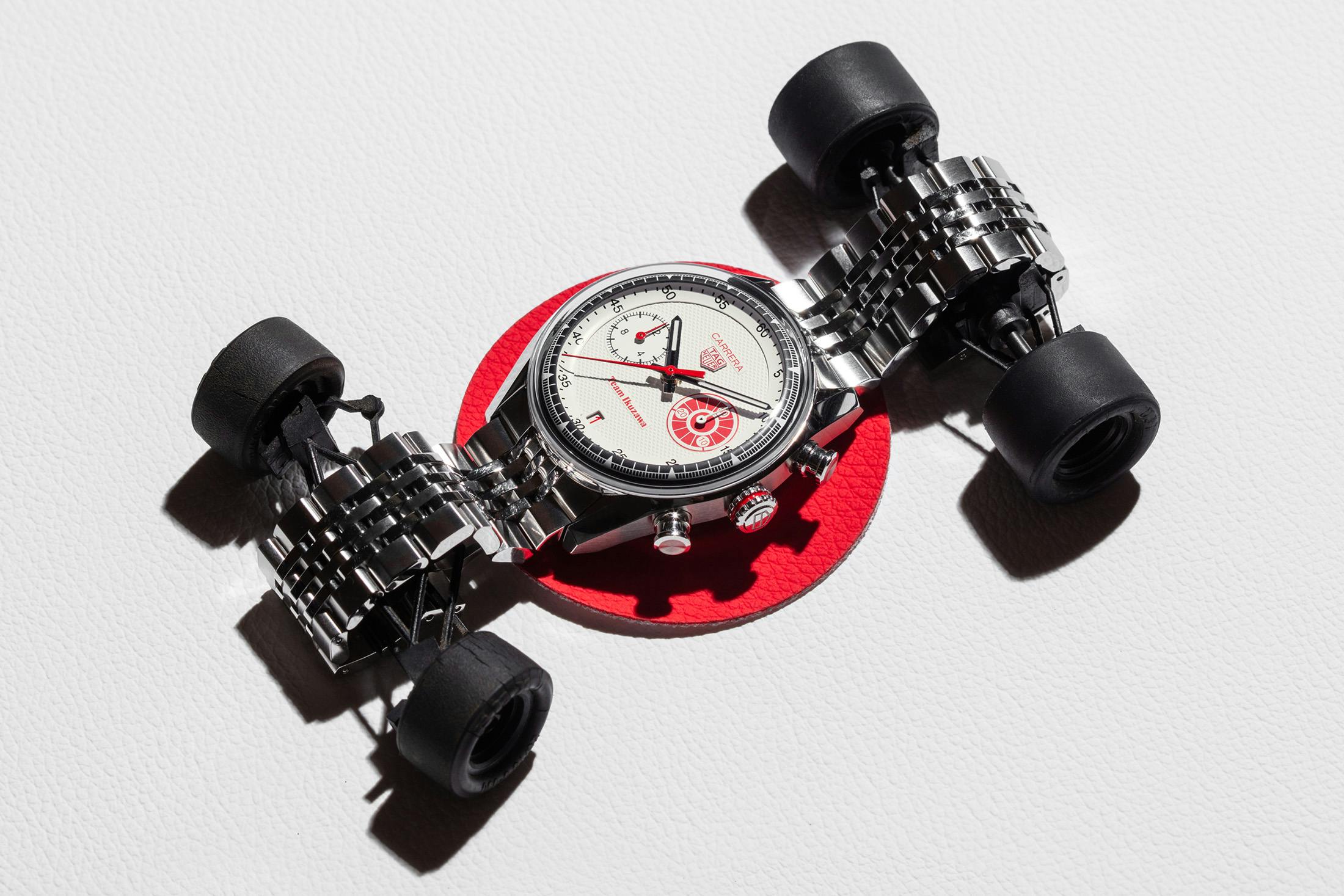
The watch ships on a seven-row stainless steel bracelet with a folding clasp. Two additional straps are included: a perforated white leather strap with red stitching, and a white textile strap with red stripes referencing Team Ikuzawa’s racing livery. Packaging takes the form of a mechanics’ toolbox-style case, supplied with a travel pouch and a set of Team Ikuzawa charms.
The edition is limited to 150 pieces. Given the Glassbox platform’s established dial architecture and the constraints of a 39mm case, the design decisions here — printed indices, suppressed running seconds, concentrated red accents — are each traceable to a specific formal or heritage rationale rather than arbitrary customisation.